Random tactics don’t build sustainable careers. Frameworks do.
Most beginners in digital marketing get trapped in tool overload. One week it is a new prompt library for ChatGPT; the next, it is an automated workflow in Zapier. Without a guiding mental model, you end up producing disconnected campaigns that burn budgets and deliver zero pipeline.
AI has made execution affordable, fast, and accessible to everyone. Because anyone can generate a 1,500-word article or twenty ad variations in seconds, strategic framing is the only defensible moat left.
Here are 8 foundational digital marketing frameworks adapted for the modern AI workflow, designed to turn beginner and intermediate marketers into strategic growth drivers.
1. The RACE Framework (Reimagined for AI Personalization)
Developed by Smart Insights, the RACE Planning Framework organizes the digital customer journey into four distinct phases: Reach, Act, Convert, and Engage.
In traditional marketing, executing RACE required disjointed teams managing separate, manual touchpoints. In modern AI-integrated marketing, predictive algorithms and automation bind these stages into a unified lifecycle.
See an example of the RACE framework diagram below-
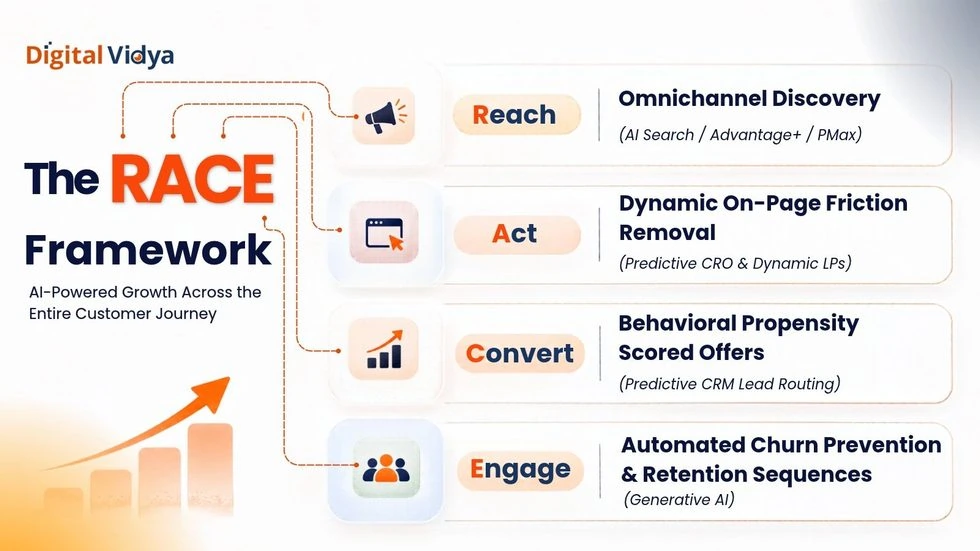
- Reach: Instead of manual audience targeting, run algorithmic awareness campaigns via Meta Advantage+ and Google Performance Max, optimizing for algorithmic intent rather than rigid demographic slicing.
- Act: Use dynamic web personalization engines to adapt landing page headlines, visuals, and proof points in real time based on referral source and visitor intent.
- Convert: Deploy predictive lead scoring models within CRMs (e.g., HubSpot AI, Salesforce Einstein) to prioritize high-intent leads and route them directly to conversion workflows.
- Engage: Feed customer engagement data into generative AI sequences to trigger proactive onboarding, value-add educational emails, and churn-prevention workflows automatically.
Even with the framework mostly automated, editing offers, CTAs, and writing follow-up emails require human supervision. Look, the end of every marketing campaign is connected to complex human beings. A consumer makes a decision to purchase based on tons of variables after watching marketing content. Without having a mandatory foundation and basic skill set of marketing, no marketing framework is sustainable in long run.
2. AIDA with Generative AI Workflow Augmentation
The classic AIDA model (Attention, Interest, Desire, Action) remains the cornerstone of direct-response copywriting and conversion design.
However, modern marketers do not use AIDA by manually writing every word from scratch. They use it as an evaluation framework to prompt and calibrate Generative AI models.
Watch an example of the AIDA structure below in the image:
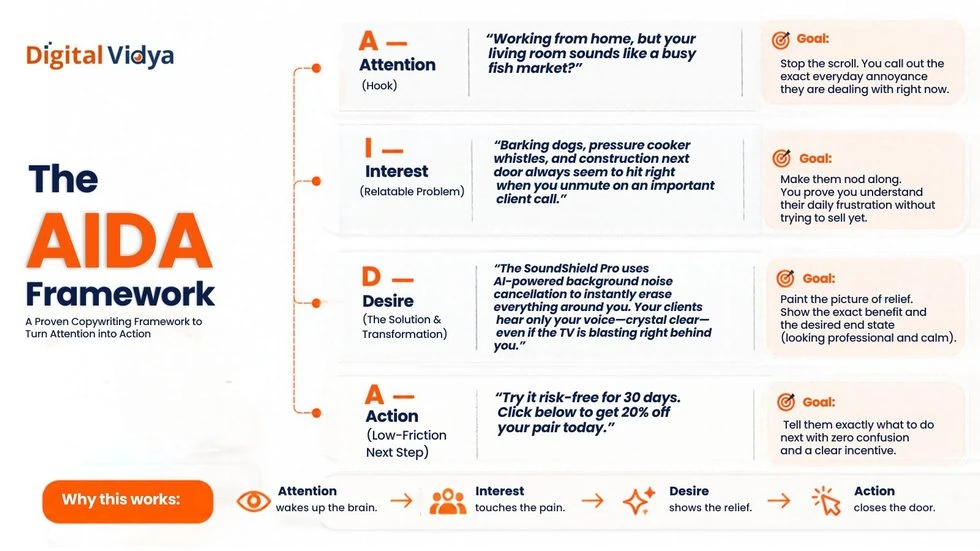
AIDA is not a magic framework in marketing. It cannot be used blindly to create real-world successful frameworks. Every marketing funnel is different, with brand, offer, audience, and ICP. Internet users and consumers are also smart enough to identify repeatable content from a framework. To get better at building community and establishing reputation, combine human needs (time, price, comfort) to create an offer and trigger curiosity with automated ad testing.
3. The Flywheel Model (Powered by Automated Feedback Loops)
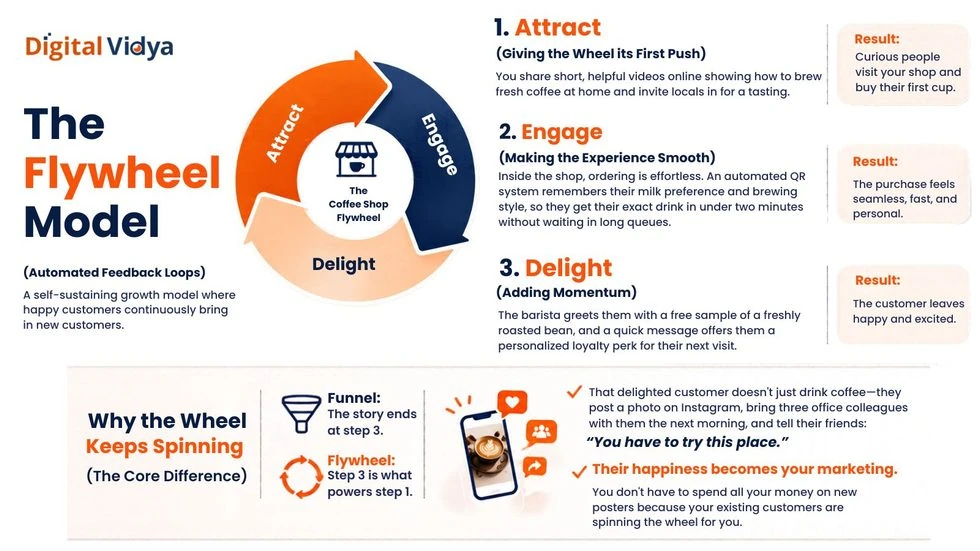
Pioneered by HubSpot, the Flywheel Model replaces the traditional linear funnel by placing Customer Delight at the center of momentum.
Funnels produce customers as an end byproduct. Flywheels store energy: happy customers drive referrals, repeat revenue, and organic advocacy, which fuels customer acquisition.
AI supercharges the Flywheel by eliminating customer friction in real time. Deploying conversational AI agents capable of resolving 70–80% of routine support requests instantly prevents customer churn.
Let’s understand: what is the Flywheel model in the image below:
Simultaneously, AI social listening tools (like Brand24 or Sprout Social AI) monitor brand sentiment across public platforms, automatically flagging detractors before negative reviews damage your inbound acquisition loop.
The Flywheel model teaches us that nothing in marketing is a trick or shortcut. Every positive, amazing, flawless experience motivates the customer to take a next step. Every quality of production and distribution makes marketing successful in reasoning.
4. The 7Ps Marketing Mix (Calibrated for Algorithmic Realities)
The traditional 7Ps (Product, Price, Place, Promotion, People, Process, Physical Evidence) were designed for physical commerce and corporate boardrooms. In an AI-first digital curriculum, each “P” undergoes a structural transformation:
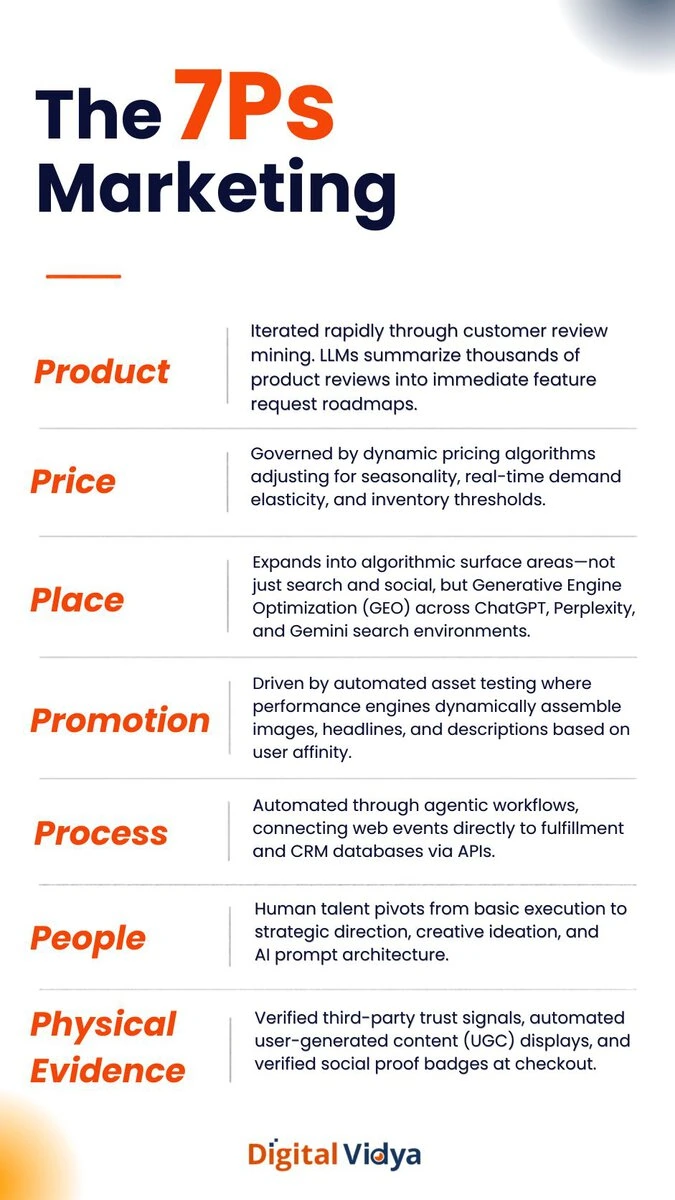
- Product: Iterated rapidly through customer review mining. LLMs summarize thousands of product reviews into immediate feature request roadmaps.
- Price: Governed by dynamic pricing algorithms adjusting for seasonality, real-time demand elasticity, and inventory thresholds.
- Place: Expands into algorithmic surface areas—not just search engines and social apps, but Generative Engine Optimization (GEO) across ChatGPT, Perplexity, and Gemini search environments.
- Promotion: Driven by automated asset testing where performance engines dynamically assemble images, headlines, and descriptions based on user affinity.
- Process: Automated through agentic workflows, connecting web events directly to fulfillment and CRM databases via APIs.
- People: Human talent pivots from basic execution to strategic direction, creative ideation, and AI prompt architecture.
- Physical Evidence: Verified third-party trust signals, automated user-generated content (UGC) displays, and verified social proof badges displayed dynamically at checkout.
Inside the CADMM classroom, we have been growing students in marketing with these 7 pillars of marketing. The 7P is not checklist of marketing but a structure of foundation in marketing. It touches every area of human life and solves problems.
5. Pirate Metrics (AARRR) for Growth Marketing & Data Attribution
Originally formulated by Dave McClure for venture-backed startups, Pirate Metrics (Acquisition, Activation, Retention, Referral, Revenue) serves as the operational blueprint for performance and growth marketers.
See the model explanation in the image below:
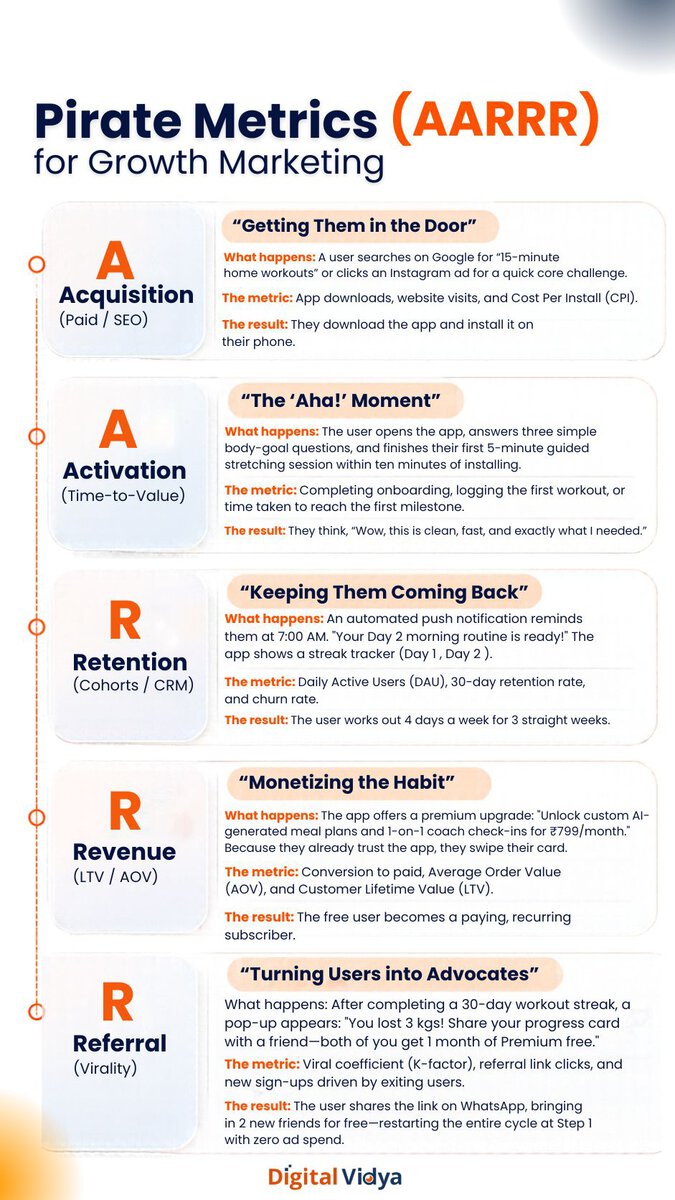
When managing multi-channel budgets, beginners often optimize exclusively for Acquisition, driving cheap clicks that never activate or convert into revenue.
Applying AARRR with AI-era tooling changes your workflow:
- Activation: Measure Time-to-Value (TTV) using product analytics platforms. Predictive models flag accounts that fail to complete key activation events within 48 hours.
- Retention: Cohort analysis engines calculate churn probability, allowing email marketing automation to trigger personalized win-back offers based on user inactivity.
- Revenue: Server-side tracking (sGTM) and First-Party data pipelines send clean offline purchase values back into Google Ads and Meta CAPI to bid exclusively on high Customer Lifetime Value (CLV) profiles.
If you want value to cash flow driven model of marketing, AARRR models works like 2-edge sword. From clarity to close, every stage is taken care of by this model. Digital direct sales and direct response marketing work well in this model.
6. See-Think-Do-Care (STDC) for Full-Funnel Content & Intent Mapping
Created by Avinash Kaushik, STDC is an audience-intent framework that prevents marketers from making one fatal error. Asking users to buy before they even know they have a problem.
- SEE (Largest Addressable Audience): Broad, non-commercial intent. AI helps you produce foundational educational content, topical glossaries, and lifestyle assets at scale.
- THINK (Weak Commercial Intent): Comparative research intent. Users compare platforms, software, and methods. You build semantic comparison hubs, data-driven buyer guides, and calculator tools.
- DO (Strong Commercial Intent): Active purchase stage. High-converting transactional pages, limited-time offers, and direct-response performance ad campaigns.
- CARE (Current Customers): Repeat purchase and advocacy stage. Predictive replenishment reminders, VIP loyalty triggers, and automated community access.
Mapping your content pipeline across STDC ensures you don’t waste budget pitching high-friction product demos to users who are still in the “See” stage.
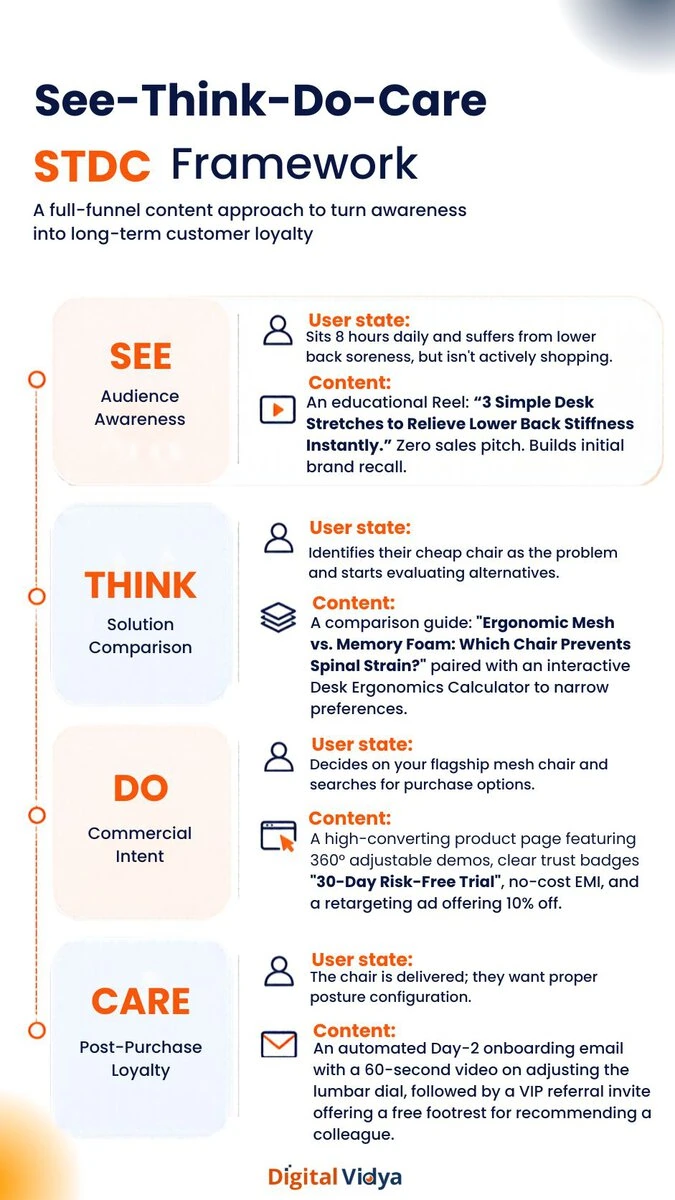
To save time, money, and resources, the STDC digital marketing framework suits well. It identifies the largest addressable market, differentiates weak commercial intent from strong intent, and current customer behaviors. Based on all these variables, it creates offers, lead magnets, content, etc.
7. The Hook Model for Digital Engagement & Habit Formation
Designed by Nir Eyal, the Hook Model explains how software platforms, apps, and consumer brands build lasting user habits. It consists of four steps: Trigger, Action, Variable Reward, and Investment.
Understanding this model is non-negotiable for social media managers, email marketers, and app growth leads. See how Duolingo is using hook models for digital engagement and habit formation:
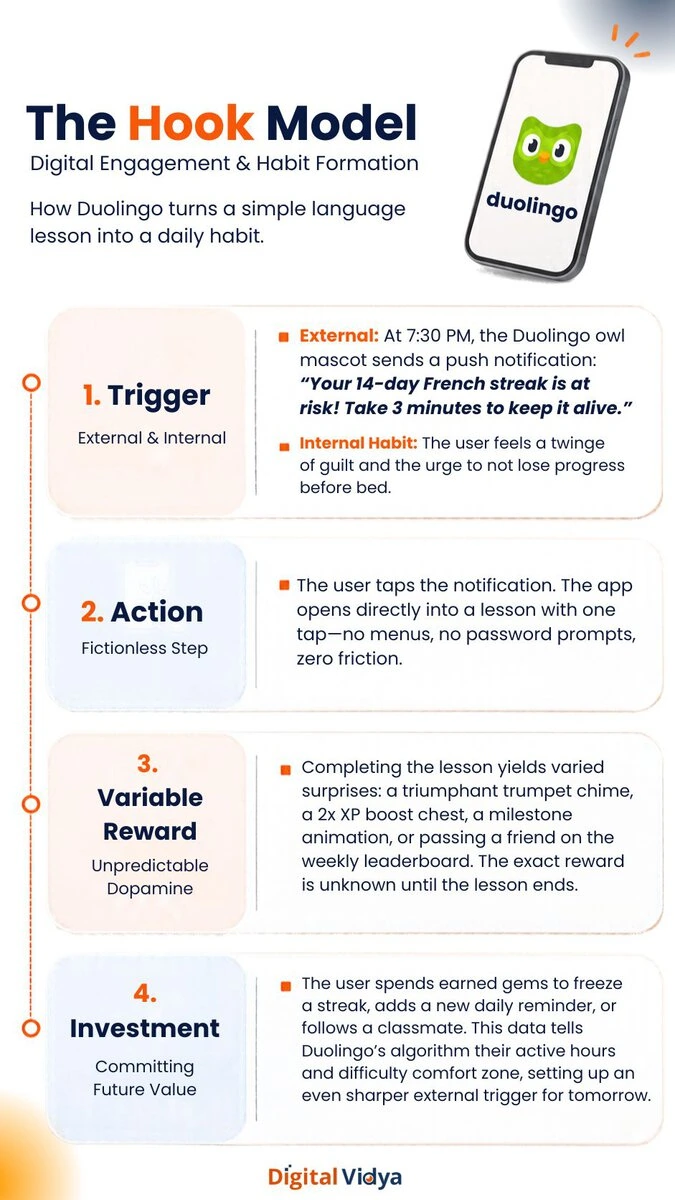
- Trigger: External cues (push notifications, personalized email triggers generated by AI) prompt the user to visit your channel.
- Action: The simplest behavior done in anticipation of a reward (opening an email, clicking a short-form video, tapping an interactive poll).
- Variable Reward: Delivering unpredictable, high-value satisfaction. AI recommendation engines (like YouTube’s or TikTok’s discovery algorithms) master this by serving personalized content feeds tailored to real-time micro-preferences.
- Investment: Asking the user to invest a small amount of effort (saving a post, configuring profile settings, inputting data). This investment feeds your system with first-party data, making future external triggers even more relevant.
In the modern market, business owners do not satisfy expectations but suppress them. This positive unpredictability value creates an unforgettable memory of the brand. All these stages of human psychology and cues can be automated and distributed to build amazing brands.
8. Entity-Attribute-Value (EAV) for Semantic SEO & Generative Engine Optimization (GEO)
Traditional SEO relied on raw keyword density. Modern search engines and AI answer engines (Google AI Overviews, Perplexity, SearchGPT) operate on Knowledge Graphs and Entities.
The EAV Framework allows digital marketers to construct search content that AI bots can parse, verify, and cite as authoritative information.
- Entity: The core subject or noun (e.g., Digital Marketing Course, Performance Marketer, Google Analytics 4).
- Attribute: The specific property or characteristic belonging to that entity (e.g., duration, startingSalary, corePrerequisites).
- Value: The factual, unambiguous data point fulfilling that attribute (e.g., 6 Months, ₹4.5 LPA, Basic HTML & Statistics).
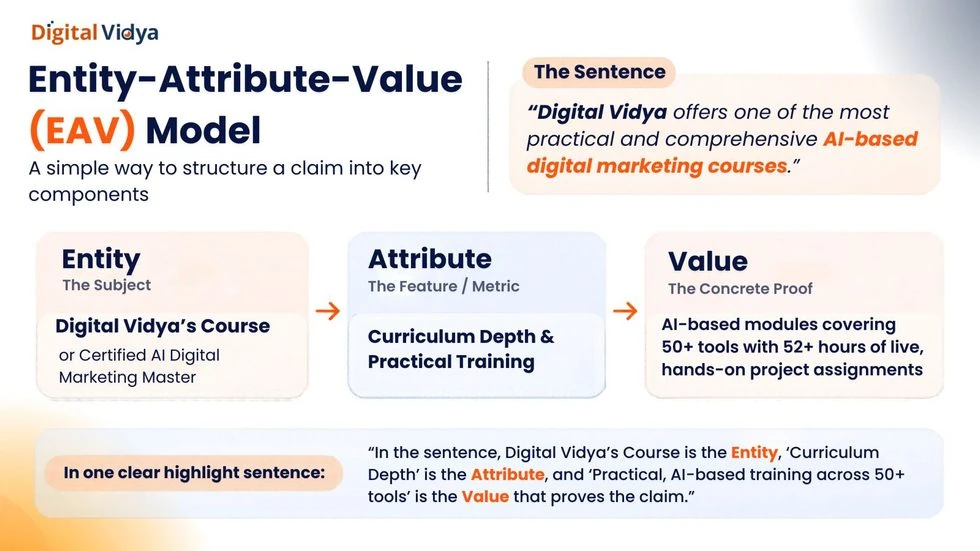
When drafting content hubs, listicles, or course pages, structuring your editorial sections around explicit EAV pairs—supported by schema markup (JSON-LD)—ensures your articles satisfy Google’s E-E-A-T benchmarks and get cited directly in AI engine summaries.
According to semantic search and SEO frameworks (such as documented in MLforSEO’s EAV Model Guide), structuring content via EAV triples directly mirrors how LLMs and modern AI search engines process query fan-outs by breaking down broad topics into attribute-specific queries.
SEO has changed a lot over the years. AI engine visibility is now a new demand for brands. But AI is not ready yet to take over all of the marketing, as the dos and don’ts of AI are unavoidable.
The E-A-V models allow you to index value per work based on need and calculative engineering. Marketing must consider a content engineering framework using this model.
Digital Marketing Frameworks: Theory to Execution
“Frameworks provide clarity; tools provide leverage.”
As an aspiring or intermediate digital marketer, your value in an AI-saturated market does not come from memorizing button placements inside ad managers or generating generic text with chatbots. The career and scope of AI is expanding
Your real value lies in diagnosing a business bottleneck, selecting the appropriate framework, and configuring AI tools. It’s for executing the strategy with speed and mathematical precision. Master the models first, and the tools will take care of the rest.
In order to master AI models in marketing, digital marketing students need a culture of daily practice from experts. Digital Vidya is one of the most practical and recognized sources of education for marketing and AI training. For a more comprehensive guide on marketing, check the curriculum of the Certified AI Digital Marketing Master (CADMM).