What are the high-demand, HR’s favorite AI skills in 2026? AI skills that hiring managers in 2026 reject candidates who simply list “ChatGPT proficiency” on a resume. Modern hiring teams evaluate how effectively professionals steer machine intelligence to protect margins, compress project cycles, and elevate output quality without creating enterprise liabilities.
The primary skill gap across modern enterprises does not center on building machine learning algorithms from scratch. It centers on operational execution. Organizations need commercial practitioners who translate strategic business objectives into structured, reproducible AI workflows.
Machine intelligence handles raw computational volume, but strategic human judgment determines commercial success. While foundational models draft copy and analyze baseline metrics, human operators direct the strategic narrative, evaluate customer friction points, and enforce brand governance. Professionals who pair core domain fundamentals with operational AI tool execution command a distinct competitive advantage across modern hiring pipelines.
To help digital marketing professionals land better jobs in marketing, we are sharing answers to “Coding AI to steering AI”, AI skills and high-demand AI skills, marketing job interviews, and portfolio tips.
1. The 2026 Hiring Paradigm: From “Can You Code AI?” to “Can You Steer AI?”
Enterprise hiring standards in 2026 prioritize operational AI steering capabilities over backend model development for commercial, non-engineering roles.
Leadership teams want practitioners who deploy AI systems to cut cycle times, eliminate workflow bottlenecks, and protect corporate brand equity. Modern commercial enterprises do not require growth marketers, content directors, or project managers to write Python code, train neural networks, or configure PyTorch libraries.
According to the Jasper State of AI in Marketing Report, 91% of marketing teams actively utilize AI in their daily operations. Modern recruitment focuses on hiring the Operational AI Integrator. This role acts as a functional bridge connecting executive commercial targets with day-to-day tool execution. An Integrator takes high-level directives—such as improving paid customer acquisition efficiency by 22%—and builds automated, human-supervised workflows to hit that benchmark. They configure targeted prompt sequences, audit outputs for accuracy, and connect tools across the tech stack to deliver reliable business assets.
Traditional, unassisted teams operate with slow, manual turnarounds.
“Writing three variations of an email nurture sequence historically required three days of copywriting, multiple rounds of client edits, and manual formatting. An AI-augmented professional uses structured context engineering and multi-model pipelines to draft, test, and package those variants in 45 minutes.”
Digital marketing skills and AI skills are not substitutes, but integrated. Speed without strategic quality control damages brand equity.
See our image diagram below about digital marketing systems in 2016 vs. modern AI-marketing systems in 20216 difference:
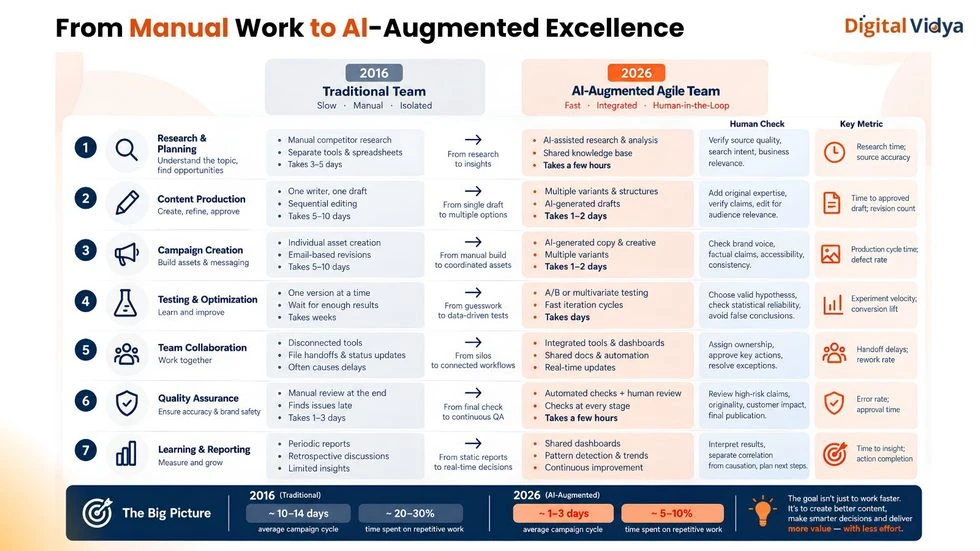
Feeding generic prompts into large language models floods marketing channels with repetitive corporate filler, inaccurate data, and disjointed messaging. Untrained staff often leak confidential data into public chat interfaces or publish hallucinated statistics that trigger customer backlash. Modern hiring managers use practical assessments to test candidates on workflow control, strategic direction, and operational risk management.
2. 10 Core AI Skills Evaluated by Modern Hiring Teams
Digital Vidya has trained 1,20,000+ students and helped them get jobs since 2009. Based on our experience, modern hiring teams evaluate candidates using 10 foundational operational AI competencies that span prompt architecture, workflow orchestration, privacy compliance, and editorial governance.
Check AI-based marketing skill stacking; most brands’ HRs are interested in the image below:
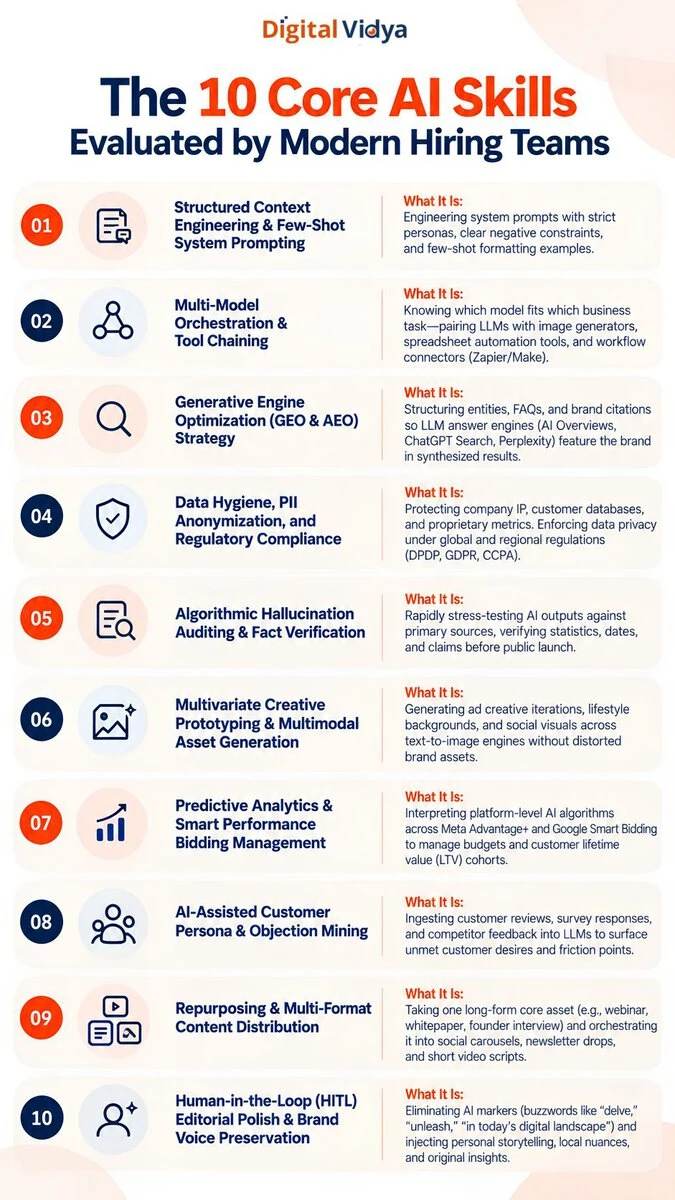
Skill 1: Structured Context Engineering & Few-Shot System Prompting
Context engineering establishes the functional foundation of modern generative output. Candidates must move beyond single-sentence prompts and build systematic prompts with strict personas, audience profiles, negative constraints, and few-shot formatting examples. An average Google search query is about 4 words, whereas an average ChatGPT search prompt is 23 words.
An efficient digital marketer knows how to label AI for thinking, scanning, structuring, and avoiding unnecessary processing and formatting output.
Interviewers test this capability by providing an unrefined brand voice guide and requiring the candidate to write an on-brand product announcement on the first generation cycle.
Skill 2: Multi-Model Orchestration & Tool Chaining
Enterprise workflows rarely rely on a single software application. Modern practitioners pair conversational models like ChatGPT and Gemini with image generators, spreadsheet automation tools, and workflow connectors like Zapier or Make. Recruiters evaluate this skill through scenario-based prompts:
“Explain how you would transform a single 30-minute customer interview transcript into a structured case study, five LinkedIn text posts, an executive email summary, and three social graphics using your current AI tool stack.”
In the marketing systems of brands, learning to search and use prompts is not a dead end of AI in marketing. Learning prompt engineering and workflow integration makes a marketer relevant and proficient.
Skill 3: Generative Engine Optimization (GEO & AEO) Strategy
Generative Engine Optimization represents the structural evolution of organic search discovery. Marketers must format entities, schema markup, and authoritative citations so answer engines like Perplexity, ChatGPT Search, and Google AI Overviews cite their domain in synthesized answers. Hiring teams test this skill by having candidates audit an existing landing page, identify informational gaps, and rewrite the structure to improve answer-engine visibility.
In a literal sense, SEO, GEO, and AEO are not distinctively different skills in marketing. Instead, these are extensions of similar skills and foundations of optimizing content, content networks, and brands for visibility and authority. If SEO refers to search engine optimization, GEO refers to Generative Engines Optimization, and AEO refers to Answer Engines Optimization. Previously, the intentional visibility goals were only on search engines, now, it’s also on various answer engines such as ChatGPT, Gemini, Perplexity, Grok, etc.
Skill 4: Data Hygiene, PII Anonymization, and Regulatory Compliance
Protecting proprietary business data and customer databases is an absolute operational requirement. Marketers must manage data privacy rules across global frameworks like GDPR and regional standards like India’s Digital Personal Data Protection (DPDP) Act. Hiring managers evaluate compliance readiness through situational interview questions:
“A junior team member intends to paste an unencrypted client database containing 10,000 email addresses into a public web AI tool to clean the fields. How do you resolve this situation?”
The answer has various technical aspects such as halting immediate copy-pasting, using enterprise-grade AI contracts or local-first models, DLP tools, and situational soft skills. But data hygiene is brand-based and context-specific in marketing protocols. It needs a strategic and instinctive skill set that marketers need to articulate.
Skill 5: Algorithmic Hallucination Auditing & Fact Verification
Generative language models calculate likely word patterns rather than consulting verified factual databases. Candidates must systematically cross-check machine outputs against primary source records before publishing. Hiring teams test this ability by providing candidates with an AI-generated whitepaper summary containing subtle factual inaccuracies to see if they identify and correct the errors during a timed audit.
Inside our CADMM classroom, Digital Vdya Trainers discuss,
“Almost every AI software claims that it can make mistakes.”
Marketing, sales, and branding involve a series of sensitive data creation and distribution. For high-quality marketing materials, automation and human touch are both mandatory for accuracy, prominence, and effectiveness.
Skill 6: Multivariate Creative Prototyping & Multimodal Asset Generation
Modern performance marketing requires testing creative visual variations at scale. Candidates must understand text-to-image prompt parameters—such as subject definition, ambient lighting, lens focal length, and negative space allocation—to generate usable creative assets without visual distortions. The basics of text-to-image generation come down to the science of fundamental chatbot prompt engineering using the “CREATE framework”.
“A short prompt gives broad, generic output, whereas a detailed, labelled, tailored prompt does not give shallow, vague output but a contextual, sharp, and nuanced answer.”
Interviewers assess this skill by asking candidates to produce three distinct ad concepts and companion visual assets for a seasonal marketing push within a 30-minute practical window.
Skill 7: Predictive Analytics & Smart Performance Bidding Management
Modern advertising platforms rely heavily on internal machine learning systems, such as Meta Advantage+ and Google Smart Bidding. Media buyers must feed high-quality first-party data into these algorithmic systems while managing audience retention and customer lifetime value (LTV) cohorts. Recruiters test this competency by asking candidates to diagnose an automated campaign. They might ask, “A brand is experiencing rising cost-per-acquisition (CPA) metrics; explain how they would adjust conversion signals to stabilize performance.”
That is where fundamental knowledge of marketing is required with AI skills. Because machines (AI) are not yet capable of resolving complex consumer psychological needs. To address this skill gap, inside our CADMM classroom, almost every week, buyer psychology and the science of marketing, with modern tools and tech.
Skill 8: AI-Assisted Customer Persona & Objection Mining
Analyzing qualitative consumer feedback reveals the underlying motivations that drive purchase decisions. Marketers use language models to process hundreds of customer reviews, forum discussions, and support transcripts to isolate recurring buyer objections. Interview teams test this skill through practical assessments:
“Review these 50 raw customer reviews for our competitor’s product. Build a prioritized markdown table outlining the top three purchase objections, unmet user expectations, and conversion triggers.”
Just 5 years ago, summarization and analysis of 100 reviews would take continuous effort of 3-4 hours. With automation and AI customer persona mining, it’s possible to produce a full report within 100- 500 seconds.
Skill 9: Repurposing & Multi-Format Content Distribution
Content repurposing maximizes the return on investment for high-value media assets. Candidates must extract core insights from long-form webinars, whitepapers, or keynote transcripts and adapt them into channel-specific formats. According to TapVid, approximately 1 to 5 hours of time is saved using AI content curation.
Evaluators assess this skill with timed exercises, such as converting a 500-word product release note into a five-slide visual carousel outline and two email subject hooks in under 20 minutes. See more do’s and don’ts of AI in this guide for live prompt examples of content repurposing in point 4.
Skill 10: Human-in-the-Loop (HITL) Editorial Polish & Brand Voice Preservation
Relying entirely on machine-generated drafts dilutes brand identity and search rankings. Experienced editors remove generic phrasing—such as “delve,” “testament,” and “in today’s digital landscape”—and weave in brand stories, case study data, and distinct points of view.
“Marketing is psychological, emotional first, logical second. Irrelevant, vague, and generic messages (Hooks, offers, CTAs) often dilute clarity and trust.”
Interviewers evaluate candidates by having them rewrite a generic, AI-generated blog introduction into an authoritative, high-converting perspective piece.
3. How Interviewers Score AI Competency: The 3-Stage Practical Assessment
Modern interview pipelines evaluate candidates through 3-stage practical evaluations designed to test applied problem-solving, analytical rigor, and commercial judgment under real-world conditions. Multiple-choice tests and theoretical questionnaires have been replaced by hands-on assessments.
The 1st evaluation stage focuses on the Live Prompt Teardown. The interviewer presents a vague prompt—such as “write five Facebook ads for our software”—along with its generic output. The candidate must diagnose why the initial prompt failed, explain the model’s token prediction behavior, and rewrite the query using a structured framework with
- defined roles
- audience pain points
- tone boundaries
- formatting rules
Candidates must deliver on-brand, conversion-focused copy on their next generation attempt.
The 2nd stage tests candidate oversight through the Output Audit Challenge. The interviewer provides an unedited, machine-generated draft containing subtle data hallucinations, invalid citations, and repetitive filler phrases.
Candidates must:
- audit the copy line by line
- verify factual claims against primary data sources
- remove robotic wording
- ensure no confidential information was leaked
This stage filters out candidates who rely on unvetted machine drafts without proper fact-checking.
The final evaluation stage centers on the Commercial ROI Justification. Candidates must walk through their proposed workflow and defend its business viability.
How do brand HRs check the quality and quantity of automation for marketing? Interviewers challenge the candidate to demonstrate how their chosen AI workflow shortens production cycles, reduces freelance spend, or improves campaign velocity without sacrificing output quality. Candidates must articulate the business metrics behind their workflows, proving that their approach delivers measurable financial returns.
Soft skills, broad knowledge needs, and demands of brands, and articulating technical skills gives top-notch advantages to prepare for interviews for digital marketing jobs.
4. The Pitfalls: 3 “AI Red Flags” That Immediately Disqualify Candidates
Most HRs use precise qualifiers to identify red flags during interviews. It saves time, resources, and maintains the quality of interns. Hiring teams quickly eliminate candidates who demonstrate 3 critical operational red flags during the application and interview process:
Red Flag 1: Unedited Machine Applications
Submitting unedited cover letters, writing samples, or screening responses that contain default system phrases signals a lack of professional oversight. When an application includes opening lines like “Certainly! Here is a compelling cover letter tailored to your job description,” hiring teams discard the file immediately. This mistake demonstrates that the candidate relies on automated generation without reviewing or refining their work.
Red Flag 2: Inability to Troubleshoot Failed Generations
Amateur tool users struggle to explain why a generation failed or how to correct it. When an initial generation misses the mark, unprepared candidates simply re-run the same prompt or add vague follow-ups like “make it better”. Qualified practitioners diagnose the underlying issue—such as ambiguous role assignments, missing negative constraints, or insufficient few-shot examples—and adjust the input parameters methodically.
Red Flag 3: Tool Fluency Without Marketing Fundamentals
Using generative software without understanding core commercial principles produces ineffective marketing campaigns. Candidates who generate dozens of social posts but cannot explain basic concepts like customer acquisition cost (CAC), attribution modeling, or conversion funnel stages cannot drive business growth. Artificial intelligence serves as a workflow accelerator; it cannot compensate for an absence of strategic marketing fundamentals.
5. How to Build an Employable AI Portfolio
Building an employable portfolio requires documenting applied, reproducible campaign workflows that solve concrete business challenges. Candidates transitioning into the industry cannot rely on static resumes filled with vague tool lists; they must showcase documented proof of their strategic and execution capabilities.
An effective portfolio includes three practical case studies:
- Audience Sentiment Analysis: Ingest customer reviews from an established brand, organize the feedback into distinct objection categories using structured prompts, and develop a conversion strategy based on those findings.
- AEO Content Optimization: Audit an existing, underperforming article, restructure its schema and entity relationships, and document how the revised version targets answer-engine citations.
- Multichannel Campaign Workflow: Document how you transformed a single source asset—such as a founder interview—into a complete campaign featuring email sequences, paid social variations, and visual concepts.
Consider watching an example of a portfolio in the image below:
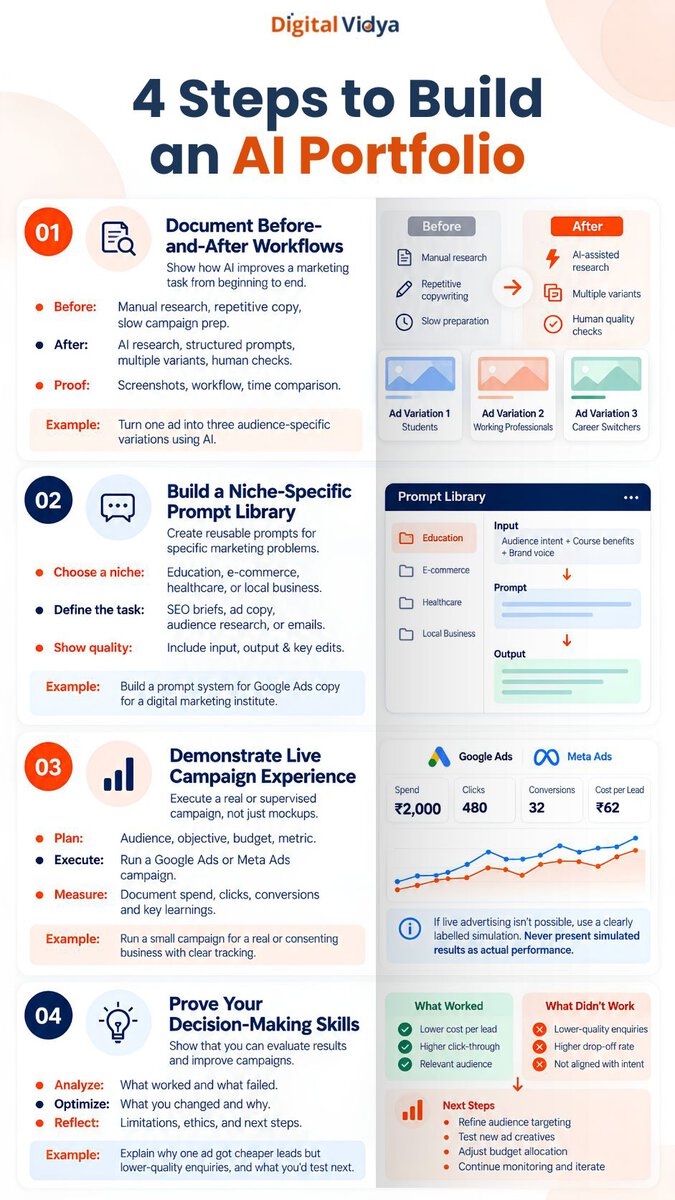
Experimenting with free web tools eventually hits a ceiling. Enterprise teams manage actual advertising capital, track multi-touch attribution, and evaluate real return on ad spend (ROAS). Candidates who manage live campaigns with structured budgets and expert feedback build the practical confidence required for senior roles.
Digital Vidya’s Certified AI Digital Marketing Master (CADMM) program provides this practical, real-world training environment. Students work with allocated advertising budgets, run live performance campaigns, and deploy structured AI workflows under the direct guidance of seasoned industry mentors. This practical curriculum bridges the gap between basic chatbot usage and the strategic, measurable execution demanded by top enterprise employers.
6. Conclusion: The Real Competitive Advantage in 2026
Artificial intelligence software has been widely democratized, but strategic operational judgment remains scarce. Modern tools like ChatGPT and Gemini are universally accessible across the globe; access alone no longer creates a professional advantage.
The professionals securing top marketing and growth roles are those who combine core commercial strategy, data compliance standards, and systematic execution workflows. They treat generative tools as an operational engine while providing the critical 20% human touch: original perspective, customer empathy, and rigorous editorial oversight.
Developing this integrated expertise transforms ambitious practitioners into high-impact assets capable of driving predictable, sustainable business growth across any modern enterprise.