Searching for the best ways to learn AI skills for digital marketing specialization is simply about learning and using AI for high ROI marketing. In most AI training institutes, learning AI is the most popular topic to get jobs. In reality, marketing and AI education is not basic prompting skills. In this guide, we have discussed 10 methods to practice and learn AI for becoming a high-impact digital marketer. Take a quick look at the “why of marketing” before diving into the “how-to” of marketing using ethical practices.
1. The “Logic-First” Foundation: Marketing Psychology Before Prompting
“A marketer with strong marketing skills and knowledge uses AI far more effectively than someone amateur in marketing uses it”
In order to become good to excellent in marketing and AI, knowing the why of marketing is more crucial than knowing how to write a prompt. According to a study analyzing the balance between automation and human insight featured by Averi.ai, while AI speeds up content generation by 59%, purely human-driven strategic execution yields 5.44 times more traffic and 41% longer engagement than raw AI output.
In our digital marketing classes at CADMM, we do encourage similar practice of basic, static, non-expert prompts vs. expert-level prompting for similar queries on Gemini. The results are often trimmed, accurate, and effective for specific needs rather than contextless, shallow, precise, quick queries.
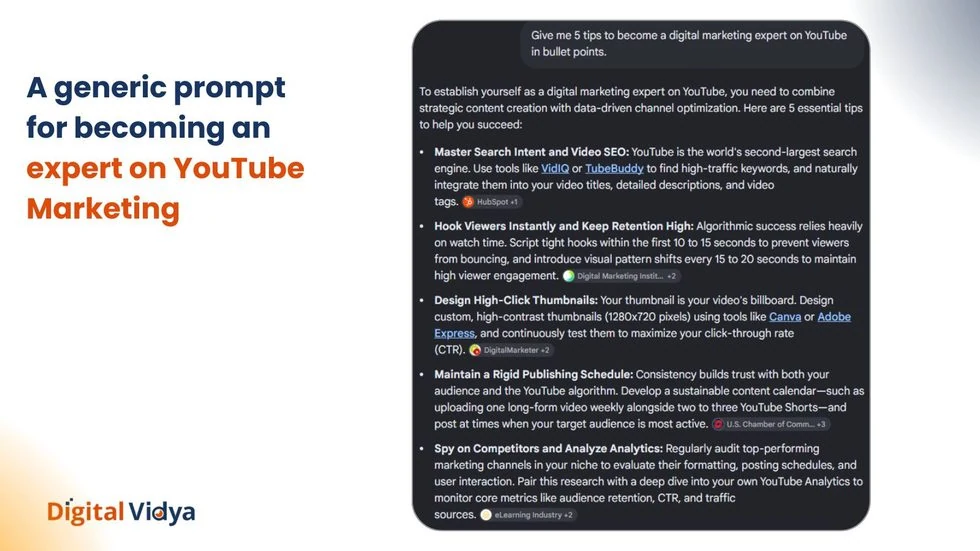
For example, we have asked Gemini, “Give me 5 tips to become a digital marketing expert on YouTube in bullet points.” See the image below. The output is static and not effective for real-world problem-solving in YouTube Marketing.
And the 2nd Prompt we tested was by an expert in Marketing: “ Think like a YouTube expert in the finance niche. Now, tell me how I can become an expert on YouTube in the finance niche and attract high-paying clients for Chartered Accountants (C.A). Give me tips on preparation, skill building, landing page, and Personal branding for me in 5 simple bullet points.” as you can see in the image below:
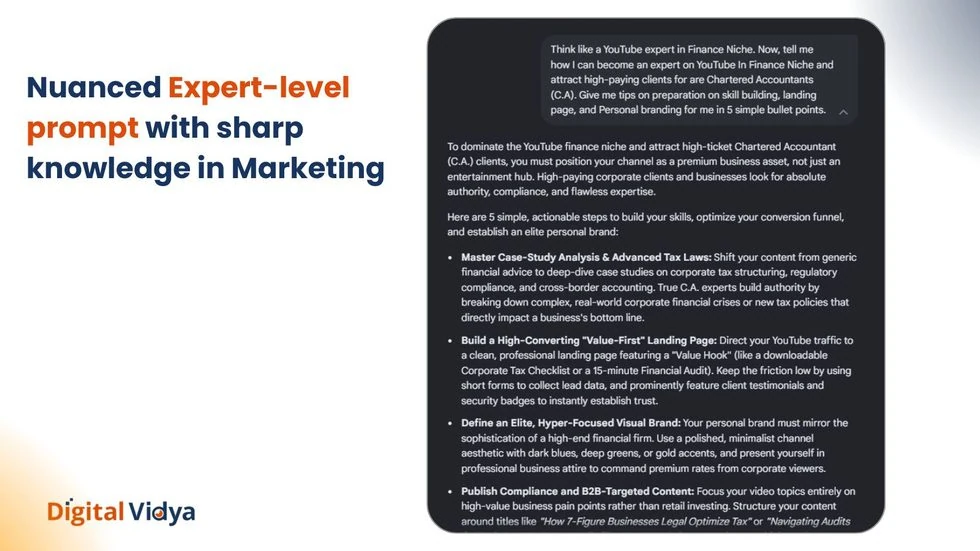
The output with the expert-level prompting is 10X more effective in order to build skills, become an expert, and position yourself to land clients based on requirements.
“Prompt engineering without foundational knowledge in marketing is similar to flying a jet plane without knowing how to land…”
2. Multi-Persona Prompt Engineering: Role-Constraint-Context (RCC) Framework
The biggest difference between search queries in search engines vs. commanding a task to an AI chat or agent is the granularity level of information. Users are open to asking questions and giving tasks to ChatGPT from 13 different angles and criteria. It can think, scan, write, and solve problems according to your instructions.
“The average ChatGPT prompt length is 23 words, whereas the average Google search query is only 3.4 words.”
Teach the Negative Constraint Technique (banning algorithmic buzzwords like “buy now”, “game-changer”, “testament to”). Provide a plug-and-play prompt matrix specifying.
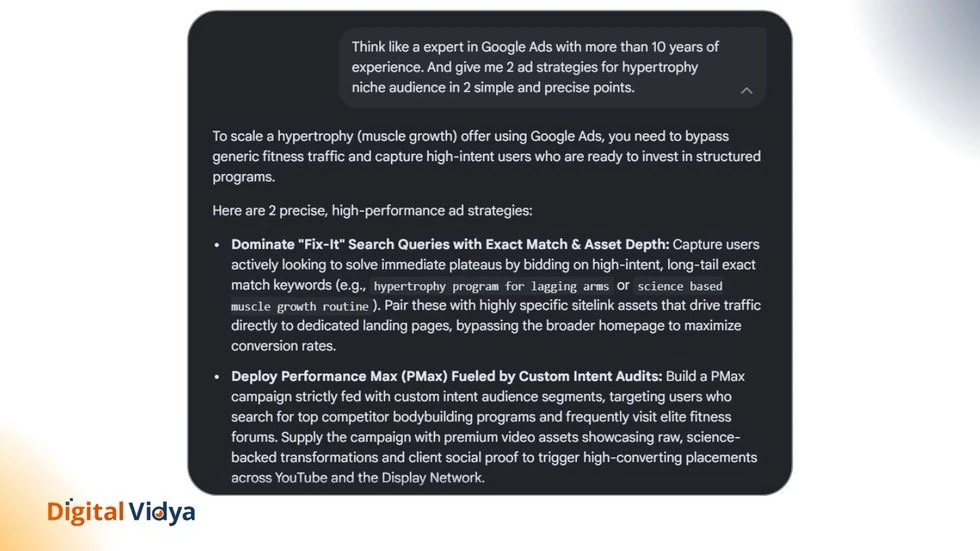
Here is a basic instruction to ChatGPT to find strategies for finding out strategies in Google Ads and its output below:
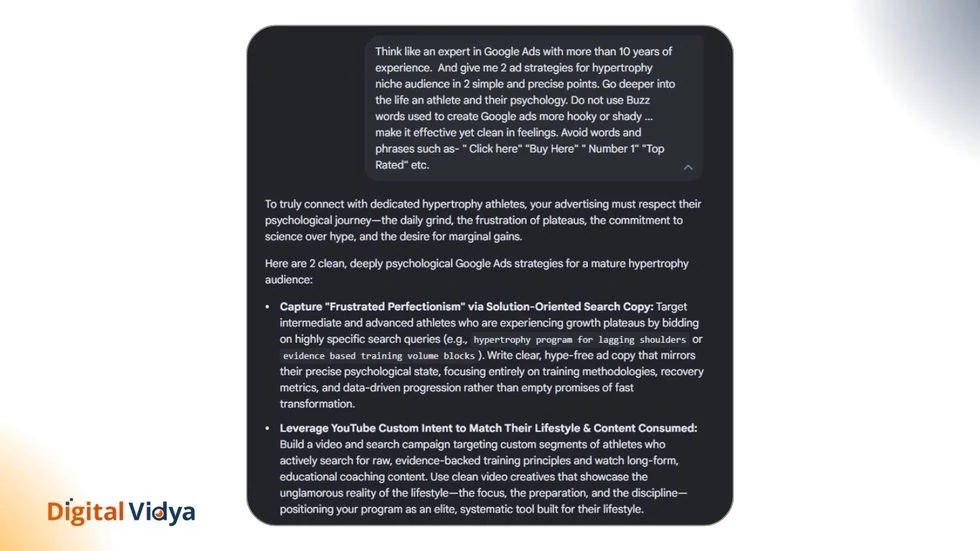
Later, we tried an additional prompt structure, and the output is nuanced and sharp:
3. Focus On Semantic Keyword Clustering & Entity Extraction (Beyond Search Volume)
Modern search engines do not rank pages based on isolated keyword density; they rank coherent entities and topical clusters. The landmark study analyzed over 50 million AI search prompts and found that generative search intent has become the top intent category, accounting for 37.5% of all queries.
AI helps to understand 8 different intents behind a search query. It reveals all important possible contexts, research, and missing information that needs to be discussed. Entity extraction and semantic keyword clustering have taken weeks of work; now it is a matter of 7-30 seconds and 3-5 hours of brainstorming.
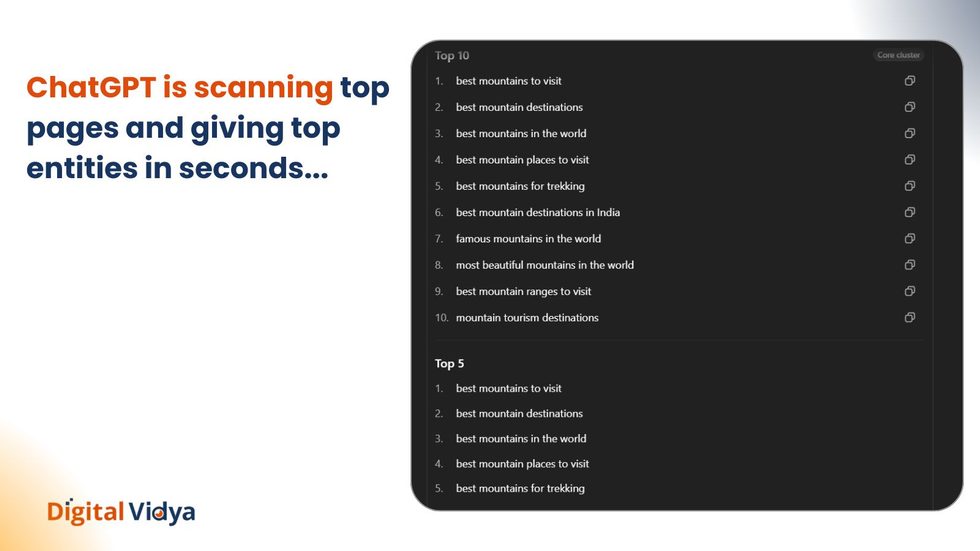
From lessons of CADMM, we have taken an example of entity extraction automation here using a keyphrase “best mountains for tour in the world” and the top 3 ranked websites.
Firstly, we created a PDF file using all the written content for future research and reference. Then, we uploaded the PDF to the chat prompt.
“Think like world class semantic SEO specialist and scan the PDF of our competitors and tell me top 20, 10, top 5, top 3 key phrases that are highly prioritized by those pages…. And create a table and fill the keyphrases in the column for the keyword, “best mountains for tour”
Lastly, the command is simply to extract semantic key phrases related to “best mountains for tour” from there.
Entity scanning and key research is popular in “Keyword research tools”; however, AI chats are now free and open to do a customer-wide range of entity scanning for free with multiple conditions and filters.
4. Practice Generative Engine Optimization (GEO) & Answer Engine Optimization (AEO)
In an era where over 60% of searches end without a website click, learning SEO requires optimizing content to be cited by LLM answer engines. Good and successful content does not have qualities like vague information, fuzzy answers, clickbait, and delayed answers.
People on Google or other search engines are used to getting AI overviews and quick answers. A brand web presence must be clear, structured, and easy to find information. Delaying answers and serving them later to pull them into the page does not serve well for a marketing campaign in GEO or AEO.
In our CADMM course, we emphasize the “Direct Answer Architecture”: train students to lead every H2/H3 section with a concise, factual 40-word definition containing entity attributes, followed by original empirical data. Explain how LLMs parse structured markdown tables to pull citations into AI summaries.
5. Aim for Algorithmic Paid Media: Managing AI-Driven Ad Engines
Paid advertising is no longer a guesswork. A performance marketer can use AI to test ad variations (Visuals and textual hooks, offer, lead magnets), budget, and ROI without burning investments on fuzzy ad copy. Large-scale ad testing data and pattern recognition using AI decrease risk factors in campaign performance and increase the possibility of ROI.
According to aggregated performance data published in a market analysis by AI Business Weekly and compiled by Seo.com, using machine learning to handle large-scale ad testing (such as variations in ad copy, hooks, and visuals) directly minimizes the financial risk of manual “fuzzy” ad copy while significantly elevating campaign ROI.
To practice algorithmic paid media, train beginners on the 10x Dynamic Angle Matrix: using AI to take one core product value proposition and splinter it into 10 emotional angles (FOMO, financial savings, social status, speed, risk reversal) within 15 minutes to feed Meta’s algorithm without causing creative fatigue.
6. Use Voice of Customer (VoC) Mining via Unstructured Data Analysis
The gap between human intelligence complexity and machine readability is gradually decreasing for communication, automation, marketing, and digital media storytelling and distribution. Machines and technologies in marketing are capable of processing neuro-linguistic programming, tonality, and sentiment analysis, etc. Therefore, brand owners and marketing executives are eager to hire professionals who can help them understand customers using automation.
According to the Robert Half 2026 Marketing Job Market Report, job postings for specialized AI and technology-driven positions have seen sustained growth, specifically highlighting that the role of Marketing Automation Manager saw a 10% year-over-year growth. Furthermore, the study noted a severe talent shortage, reporting that 37% of marketing teams suffer from a skills gap in marketing automation and another 37% lack the talent needed for AI integration into workflows.
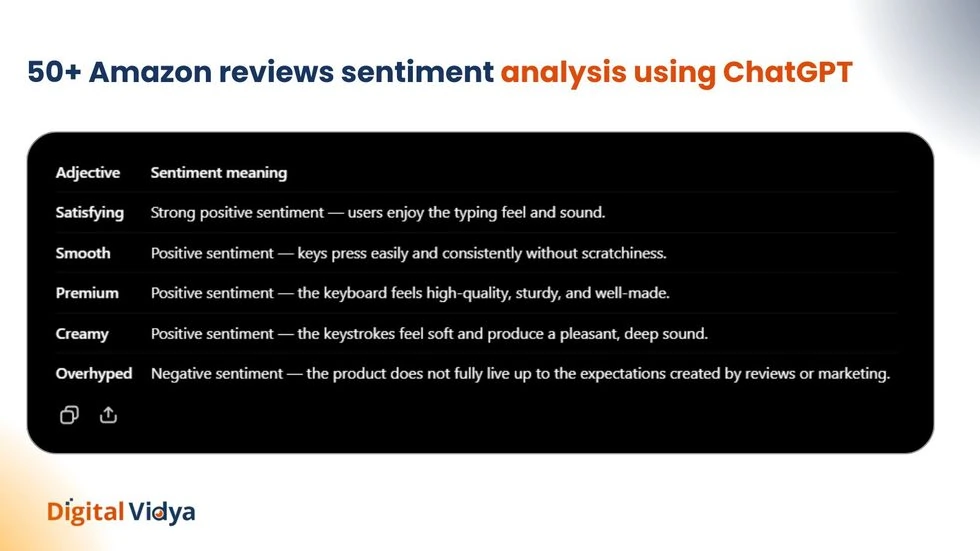
For practical sentiment analysis, we are sharing a prompt test below for Amazon product review sentiment analysis.
7. Use Full-Funnel Retention: AI-Driven Email Sequencing & Behavioral Triggers
Automation has played a humongous role in marketing and sales. A specialized marketing funnel can create a scenario where “If” and “Else” cases are triggered to create email sequencing based on the subscriber’s behavior. Hence, a vast part of prospecting and lead nurturing is automated, leaving critical areas for thinking and editing. According to LeadResponse .co, automated workflows drive 37% of all email-generated sales, despite representing only 2% of total email volume.
For instance, AI can be used to generate conditional branching logic for lead nurturing. Provide a beginner case study on creating personalized 5-part welcome sequences tailored to lead magnets, contrasting generic drips with context-aware onboarding emails.
8. Understand Human-in-the-Loop Editorial Protocol (E-E-A-T Defense)
AI-contents are not decreasing the need of human creativity in marketing opposed to the norm of current fear of job markets. Large-scale AI content creation, such as written words, images, videos, and voice-overs, is increasing the demand for expert and interesting human touches. 100% AI-generated content is not the ideal percentage for most successful content creation. 20% to 30% human touches are most likely to make content creation faster and highly responsive for better performance. To decrease AI spam, search engines are actively monitoring Algorithmic Demotion, Information Decay, and Search Quality Evaluator Guidelines (Experience, Expertise, Authoritativeness, Trustworthiness).
- Algorithmic Demotion: A process where a search engine’s automated system automatically lowers a website’s ranking in search results because the content violates guidelines, appears spammy, or is of low quality.
- Information Decay: The gradual loss of accuracy, relevance, or completeness of data and online content over time because it is not updated as the world changes.
- Search Quality Evaluator: A human reviewer hired by a search engine company to rate the quality and relevance of search results based on specific guidelines, helping to train and improve the search algorithms.
Then how to leverage AI content creation without penalties or poor performance? The “80/20 Production Rule”: 80% speed via AI outlining and rough-drafting, followed by 20% high-leverage human enrichment—inserting proprietary case studies, local pricing facts, expert quotes, and verifiable screenshots that an LLM cannot hallucinate.
See more about the do’s and don’ts of marketing to avoid penalties in a marketing campaign.
9. Practice Predictive Analytics & Data Literacy
Teaching an AI model or agent pattern recognition comes down to feeding data and training the model to think in patterns and direction. This saves time, reduces mental fatigue, and supports creativity and decision-making in marketing campaigns. Marketers are open to analyzing thousands of user behavior feedback points for nuanced decision-making. It leads to accuracy and effectiveness in each campaign action.
According to recent industry data from HubSpot’s 2026 State of Marketing Report, 92% of marketers now use automation and AI specifically for data analysis and reporting. 40% of US marketing job descriptions now explicitly require AI competencies and automation workflow skills, a massive leap from just 15% at the beginning of the year.
In practice, uploading anonymized campaign CSVs directly into LLM analysis environments (ChatGPT Code Interpreter / Gemini Advanced) and running conversational queries: “Identify the 3 landing pages with the highest bounce rate relative to traffic spend and diagnose likely layout issues.”
10. Structure Live Campaign Sandbox & Proof-of-Work Portfolios
The marketing landscape and jobs have fundamentally changed when it comes to hiring criteria. A basic certification does not help you crack an interview as a qualified marketing professional. Most HR in marketing are looking for candidates with practical experience and in-hand case studies of testing. According to data tracking employer demands and the widening marketing skills gap, employers are heavily shifting their priorities toward demonstrable skills over formal degrees, resulting in a massive 47% drop in standard degree requirements for executive content marketing roles compared to previous hiring baselines.
Marketing projects are highly practical problem-solving in real time. Brands can not rely on knowledge only.
“The purpose of knowledge is action” – Aristotle
Instead of waiting for a job, students allocate a tiny test budget (e.g., ₹500 to ₹1,000 on Meta or Google Ads) to validate an AI-generated lead magnet or landing page, documenting their prompt logs, split-test results, and CAC/CPL numbers into a live portfolio case study.
Conclusion
Diving into AI tools and chat agents without knowing the foundation of marketing is a directionless marketing career choice. Candidates must focus on automation and delegation while focusing on nuances in a marketing career. Giving context and instructions makes the output of AI agents sharp and effective. To give context and instructions in marketing, you need to know the “Why of marketing”: the fundamentals of the digital marketing landscape.