
To start content writing, follow this proven path: learn SEO writing fundamentals, choose a profitable niche, create 5–10 portfolio samples, publish them on a blog or LinkedIn, and pitch clients on freelance platforms. Most beginners land their first paid project within 60–90 days — no degree required. Here is the exact step-by-step roadmap.
- Learn the fundamentals — SEO writing, audience research, and content structure
- Pick a niche — tech, finance, health, and SaaS pay the most
- Build a portfolio — 5–10 samples on a free blog, Medium, or LinkedIn
- Master AI-assisted workflows — ChatGPT and similar tools as drafting aids, with human editing
- Start pitching — freelance platforms, job boards, and direct outreach
- Set your rates — ₹1–3/word or $25–$100/hour as you gain proof
- Specialize and scale — retainers, niche authority, and repeat clients
Key Takeaways:
- 10 Essential Steps: Master industry trends, keyword research, audience analysis, and analytics tools to launch your content writing career
- Salary Insights: Content writers in India earn ₹15,000-₹50,000+ monthly; global freelancers command $25-$100+ per hour
- Portfolio Building: Create 5-10 sample pieces, start a blog, contribute guest posts, and document measurable results
- AI Integration: Leverage ChatGPT, Jasper, and SurferSEO while maintaining original voice and fact-checking accuracy
- 9 Content Types: Master blog posts, email copy, product descriptions, white papers, social media content, and more
- Freelancing Success: Top platforms include Upwork, Fiverr, ProBlogger, and Contently with earning potential of $500-$5,000+ monthly
- 2026 Market: Content marketing industry projected at $500+ billion; demand for skilled writers continues accelerating
What Is Content Writing? Complete Definition & Context
Content writing is the strategic creation of written material specifically designed to engage, educate, inform, or influence a clearly defined target audience online.
We have also compiled 22 proven content writing tips for conversion-driven marketing that complement this step-by-step guide with advanced optimization strategies for experienced writers.
Unlike traditional writing, content writing balances creativity with data-driven methodology—integrating audience psychology, search engine optimization (SEO), and business objectives into every piece.
Effective content writers combine several key competencies:
- Audience understanding – Knowing reader pain points, desires, and consumption preferences
- SEO expertise – Structuring content to rank in search engines while reading naturally
- Conversion psychology – Crafting persuasive language that drives desired actions (subscriptions, purchases, sign-ups)
- Research capability – Finding accurate information and synthesizing complex topics for diverse audiences
- Adaptability – Writing across multiple formats (blogs, emails, videos, social media) and tones
The Modern Content Writer’s Reality: In 2026, content writing extends far beyond blog posts. Successful writers combine traditional copywriting with SEO optimization, data analysis, AI tool proficiency, and multimedia thinking. The industry has evolved from simple “article writing” to strategic communication that drives measurable business results.
According to the Content Marketing Institute, companies investing in content marketing see 3x higher conversion rates than those without documented strategies.
For a comprehensive deep-dive into content writing definitions, frameworks, and advanced strategies, explore our guide on 15 tips to write truly engaging content covering persuasion techniques and storytelling frameworks.
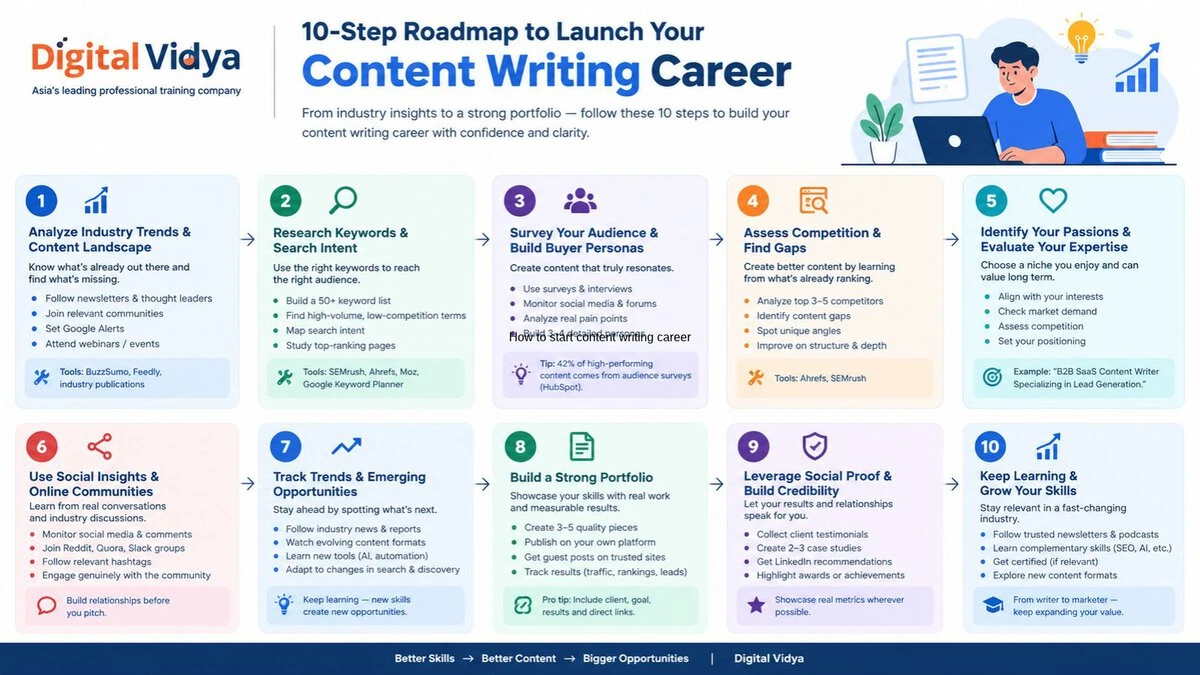
Your Complete 10-Step Roadmap to Launch Your Content Writing Career
Launching a content writing career may feel overwhelming, but a systematic approach breaks the journey into manageable phases. This comprehensive roadmap guides you from foundational research through portfolio development and market positioning.
STEP 1: Analyze Industry Trends & Current Content Landscape
Why This Matters: Understanding what’s already out there prevents creating redundant content and positions you to address unmet audience needs.
Actionable Steps:
- Subscribe to industry-specific newsletters (HubSpot, Content Marketing Institute, Marketing Dive)
- Follow 15-20 thought leaders in your target niche on LinkedIn and Twitter/X
- Join industry Slack communities, Reddit forums, and Facebook groups relevant to your niche
- Set Google Alerts for 5-10 key industry terms to track emerging trends weekly
- Attend 2-3 industry webinars or virtual conferences monthly
Tools: BuzzSumo (content trend identification), Feedly (newsletter aggregation), Industry-specific publications
Key Insight: According to Content Marketing Institute research, 61% of the most successful B2B content marketers maintain a documented strategy rooted in current industry trends. This isn’t optional—it’s a competitive necessity.
For deeper strategy insights, explore our Content Writer Skills Guide covering essential competencies.
STEP 2: Research Keyword Demand & Search Intent Mapping
Why This Matters: Keywords are the bridge between what people search for and content you create. Mastering keyword research separates successful writers from struggling ones.
Actionable Steps:
- Create a keyword research spreadsheet with 50+ relevant terms
- Use SEMrush or Ahrefs to identify high-volume, low-competition keywords (volume 1,000+ searches/month, KD < 25%)
- Analyze search intent for each keyword (informational, navigational, transactional, commercial)
- Build a “long-tail keyword list” targeting 15-30 word combinations (lower competition, higher conversion intent)
- Study the top 3-5 ranking pages for your primary keywords to understand content structure expectations
Search Intent Categories:
- Informational – “What is content writing?” (Educational, early-stage buyers)
- Navigational – “Upwork content writing jobs” (Brand/platform specific)
- Transactional – “Buy content writing course” (Purchase-ready)
- Commercial – “Best content writing tools 2026” (Research before purchase)
Tools: SEMrush, Ahrefs, Moz, Google Keyword Planner, Ubersuggest
Critical Finding: Backlinko’s analysis shows content targeting long-tail keywords (3+ word combinations) achieves 2.5x higher conversion rates than broad keywords.
Content Writer Skill Development: Keyword integration should be seamless—targeting 1-2% keyword density while maintaining natural readability. Poor keyword stuffing damages both user experience and SEO rankings.
Learn more about SEO-Focused Content Writing Techniques in our dedicated SEO guide.
STEP 3: Survey Your Target Audience & Build Buyer Personas
Why This Matters: Content that doesn’t resonate with your audience wastes effort. Direct audience research reveals pain points, preferences, and language that converts.
Actionable Steps:
- Create a Google Forms or SurveyMonkey survey with 10-15 questions targeting your ideal reader
- Conduct 5-10 one-on-one interviews with people in your target audience
- Analyze social media comments and discussions related to your niche for real pain points
- Review Reddit threads, Quora questions, and industry forums to understand common concerns
- Build 3-4 detailed buyer personas documenting demographics, goals, challenges, and content preferences
Survey Template Questions:
- “What’s your biggest challenge in [your niche]?”
- “What content formats do you prefer (blog, video, podcast, infographic)?”
- “Which publications do you trust for information?”
- “What questions about [topic] remain unanswered?”
- “How much would you pay to solve your biggest [niche] challenge?”
Research Validation: HubSpot’s data shows 42% of companies publishing high-performing content conduct regular audience surveys. This direct feedback dramatically improves content relevance. Understand Content Marketing Strategy Fundamentals for audience alignment frameworks.
STEP 4: Identify Competition Gaps & Exploit Market Opportunities
Why This Matters: Competitors reveal what works (and what doesn’t). Strategic gap analysis helps you create content with less competition and higher differentiation.
Actionable Steps:
- Identify your 5-10 top competitors using Ahrefs or SimilarWeb
- Audit their top-performing content using Ahrefs Content Gap tool
- Document what they DON’T cover but should (gap analysis)
- Note their content structure, tone, word count, and format preferences
- Identify outdated information you can refresh and improve
Competitive Analysis Template:
| Competitor | Strength | Weakness | Opportunity |
|---|---|---|---|
| Site A | Comprehensive guides | Outdated 2023 data | Add 2026 statistics |
| Site B | Great storytelling | No SEO optimization | Add keyword optimization |
| Site C | Technical depth | Poor beginner access | Add beginner-friendly intro |
Market Intelligence: A Semrush study found 78% of highly successful content marketing teams conduct regular competitive content audits. This isn’t guesswork—it’s strategic research.
STEP 5: Identify Your Core Passions & Sustainable Niches
Why This Matters: Writing about topics you love produces better work, sustains motivation through challenges, and shows in content quality.
Actionable Steps:
- List 10-15 topics you genuinely enjoy learning about
- Reflect on past experiences where you’ve had unique insights or expertise
- Identify 2-3 niche combinations where passion intersects with market demand
- Research earning potential in each passion area (some niches pay significantly more)
- Test your interest by writing 3-5 sample pieces in each potential niche
The Passion-Profit Balance: While passion matters, sustainability requires market demand. Aim for the intersection of:
- Topics you enjoy researching and writing about (passion)
- Topics your target audience desperately needs (demand)
- Topics with sufficient search volume and client budgets (profitability)
Supporting Data: Orbit Media’s research shows bloggers who report “strong results” are 50% more likely to write about topics they’re genuinely passionate about. Authentic enthusiasm translates to better writing and reader engagement.
STEP 6: Evaluate Your Expertise & Competitive Positioning
Why This Matters: Your unique combination of experiences and knowledge differentiates you from thousands of other writers competing for the same opportunities.
Actionable Steps:
- Document your professional background, degrees, certifications, and relevant work experience
- List skills developed through hobbies, side projects, or volunteer work
- Identify 3-5 areas where people regularly ask you for advice or expertise
- Research which combinations of skills command premium rates in the market
- Assess gaps in your knowledge and create a learning plan to fill them
Expertise Positioning Strategy:
Instead of positioning as a “general content writer,” identify a specific expertise combination:
- “Content Writer for Fintech Startups” (finance + tech + startup knowledge)
- “SaaS Product Copy Specialist” (software understanding + conversion psychology)
- “Healthcare Content Writer with Nursing Background” (medical accuracy + lived experience)
Research Validation: The Content Marketing Institute reports 96% of successful content marketers build audiences that view their organization as credible and trustworthy. This credibility comes from demonstrated expertise.
Explore Content Writer Job Description & Requirements for industry standards.
STEP 7: Leverage Social Media Insights & Platform Intelligence
Why This Matters: Social media reveals real-time audience interests, content preferences, and emerging opportunities before they appear in search data.
Actionable Steps:
- Monitor trending hashtags in your niche using Twitter Advanced Search and LinkedIn trending sections
- Analyze engagement metrics (likes, shares, comments) on high-performing posts in your niche
- Study comment sections to identify unaddressed questions and pain points
- Track which content formats (carousels, videos, threads, infographics) generate the highest engagement
- Identify influencers and thought leaders your audience follows and engage with their content
Platform Strategy by Audience Type:
| Platform | Best For | Content Format |
|---|---|---|
| B2B, professionals, thought leadership | Long-form posts, carousel posts | |
| Twitter/X | Real-time trends, industry news, conversations | Threads, hot takes, news commentary |
| Visual storytelling, lifestyle, B2C | Carousels, Reels, educational graphics | |
| TikTok | Younger audiences, entertainment + education | Short-form video, trends, personality |
| Deep community engagement, authentic discussion | AMAs, detailed responses, community participation |
Data-Driven Insight: Sprout Social reports 85% of marketers use social media data to inform their content strategies. This direct channel to audience psychology is invaluable.
STEP 8: Monitor Google Trends & Capture Emerging Opportunities
Why This Matters: Google Trends shows search volume trends over time, seasonal patterns, and emerging topics before they become saturated with competition.
Actionable Steps:
- Input your primary keywords into Google Trends and analyze 12-month trends
- Compare multiple related keywords to identify which are gaining traction
- Explore the “Related Queries” section for unexpected content opportunities
- Identify seasonal trends in your niche for timely content planning
- Set up notifications for rising search terms relevant to your expertise
Trend Analysis Questions:
- Is this keyword rising, stable, or declining?
- Are there specific geographic regions with high interest (potential geographic targeting)?
- How does this keyword trend seasonally (can I plan content calendar around peaks)?
- What related terms appear alongside my primary keyword?
Industry Insight: SEMrush’s research found 38% of successful marketers use Google Trends for content research and planning. It’s one of the highest-ROI free tools available.
STEP 9: Conduct Deep Market Analysis & ROI Assessment
Why This Matters: Understanding your market’s size, structure, profitability, and growth trajectory helps you make strategic decisions about specialization and positioning.
Actionable Steps:
- Research target market demographics (age, income, education, profession)
- Study market size and growth rates using Statista, IBISWorld, or industry-specific reports
- Analyze customer acquisition costs (CAC) and lifetime value (LTV) in your target market
- Assess market maturity (emerging, growth, mature, declining) and competitive intensity
- Identify underserved audience segments with high purchasing power
Market Analysis Framework:
| Factor | Research Method | Implication |
|---|---|---|
| Market Size | IBISWorld, industry reports | Demand and revenue potential |
| Growth Rate | Government data, analyst reports | Long-term viability |
| Competition | Competitor analysis | Saturation and positioning difficulty |
| Customer Value | Client research, case studies | Pricing power |
| Emerging Trends | Industry conferences, reports | Future-proofing |
Strategic Application: Content Marketing Institute data shows 65% of successful content marketers conduct audience research at least twice annually, adjusting their strategy based on market shifts.
For market context on how content writing fits into the broader digital marketing strategy landscape, explore our comprehensive overview covering SEO, social media, email marketing, PPC, and content marketing as interconnected disciplines.
STEP 10: Master Analytics Tools for Data-Driven Optimization
Why This Matters: Content marketing without measurement is guesswork. Analytics transform your writing from an art to a precision discipline with measurable ROI.
Actionable Steps:
- Set up Google Analytics 4 (GA4) to track visitor behavior and conversion paths
- Configure Google Search Console to monitor search performance, impressions, and click-through rates
- Install SEO tools like SEMrush, Ahrefs, or Moz for competitive benchmarking
- Use BuzzSumo to analyze social sharing and content performance
- Create a “content performance dashboard” tracking KPIs weekly
Essential Metrics to Track:
| Metric | Definition | Action When Low |
|---|---|---|
| Click-Through Rate (CTR) | % of impressions resulting in clicks | Improve title/meta description |
| Average Position | Average search ranking for keywords | Improve content quality/depth |
| Bounce Rate | % of visitors leaving after one page | Improve introduction/engagement |
| Time on Page | Duration visitors spend reading | Check content depth and readability |
| Conversion Rate | % of visitors completing desired action | Strengthen CTA and value proposition |
| Organic Traffic | Visitors from search engines | Expand to new keywords |
Research Validation: Orbit Media’s study found bloggers who consistently use analytics are 75% more likely to report strong results than those who don’t.
Explore our comprehensive guide on Content Writing Tools & Software.
How to Position Yourself as a Professional Content Writer
Beyond the 10 foundational steps, professional content writers need a clear niche, strong portfolio, credibility, networking, and continuous learning.
1. Develop a Distinctive Writing Voice
Your writing voice combines word choice, sentence structure, tone, and perspective.
- Study 20–30 writers in your niche.
- Experiment with different tones and styles.
- Write consistently to develop fluency.
- Create a simple voice-and-tone guide covering vocabulary, sentence length, formality, and brand style.
Your voice should make content recognizable while keeping the reader’s needs central.
2. Build a Powerful Content Writing Portfolio
A strong portfolio demonstrates capability more effectively than credentials alone.
- Create 3–5 high-quality pieces in your target niche.
- Include varied formats such as guides, case studies, opinions, and technical content.
- Publish them on a website, Medium, WordPress, or Substack.
- Seek guest-post opportunities on relevant industry publications.
- Track measurable outcomes such as traffic, rankings, engagement, leads, and conversions.
- Replace weaker samples with stronger work regularly.
For each portfolio piece, show the client/publication, objective, results, and link to the published work.
3. Leverage Social Proof & Build Credibility
Social proof helps demonstrate reliability and results.
Focus on:
- Client testimonials highlighting specific outcomes.
- 2–3 concise case studies showing challenges, strategy, execution, and results.
- LinkedIn recommendations and relevant professional connections.
- Industry awards, competitions, or third-party recognition.
- Quantifiable achievements such as traffic growth, impressions, engagement, or leads.
Use specific metrics wherever they are genuinely available.
4. Specialize in a High-Demand Niche
Specialization can help writers differentiate themselves and target better-fit opportunities.
Choose a niche by evaluating:
- Personal interest and relevant expertise.
- Market size and growth.
- Competition and content quality.
- Client demand and earning potential.
Examples include:
| Niche | Typical Positioning |
|---|---|
| B2B SaaS | Lead-generation content |
| Finance/Fintech | Specialized financial content |
| Healthcare | Patient and medical content |
| Legal Tech | Industry-specific technical content |
| E-commerce | Product and conversion content |
Instead of calling yourself a general writer, position yourself specifically—for example, “SaaS Content Writer Specializing in B2B Lead Generation.”
5. Network & Collaborate Within Your Industry
Professional relationships can create opportunities beyond cold pitching.
- Engage consistently with relevant professionals on LinkedIn.
- Participate in Slack, Reddit, Quora, and industry communities.
- Attend conferences, webinars, meetups, and virtual events.
- Collaborate with writers, designers, developers, and marketers.
- Identify potential clients or collaborators and engage with their work before reaching out.
- Personalize outreach around their specific content or business needs.
Focus on building mutually valuable relationships rather than immediately selling your services.
6. Continually Educate Yourself & Stay Current
Content marketing changes quickly, so ongoing learning is essential.
Stay updated:
- Follow relevant newsletters, publications, podcasts, and industry experts.
- Learn one complementary skill regularly, such as SEO, AI tools, video scripting, or conversion copywriting.
- Apply new skills to real projects.
- Consider relevant certifications in content marketing, analytics, or SEO.
- Track emerging formats such as AI-assisted content, interactive experiences, data visualization, and short-form video.
- Understand how search and content-discovery systems continue to evolve.
Developing complementary skills can help you progress from content writer toward a broader digital marketing role.
Understanding Content Writing Salary & Income Potential
Critical Insight for Career Planning: Content writer income varies dramatically based on experience, specialization, location, and business model. Understanding earning potential helps you set realistic income goals.
Content Writing Salary by Location & Experience (2026)
India Market:
- Beginners (0-1 year): ₹15,000-₹25,000/month or ₹500-₹1,000 per article
- Mid-Level (2-4 years): ₹30,000-₹50,000/month or ₹1,000-₹2,500 per article
- Senior/Specialized (5+ years): ₹50,000-₹100,000+/month or ₹3,000-₹10,000+ per article
Global Freelance Market (USD):
- Beginners: $15-$30/hour or $100-$300 per article
- Intermediate: $30-$75/hour or $300-$1,000 per article
- Advanced/Specialized: $75-$150+/hour or $1,000-$5,000+ per article
- Executive/Strategic: $150-$300+/hour
AI-Assisted Content Writing: Leveraging Tools While Maintaining Originality
2026 Reality: AI writing tools (ChatGPT, Jasper, Claude, Copy.ai) are now standard in professional content writing. The question isn’t whether to use them—it’s how to use them effectively while maintaining quality and originality.
Recommended AI Tools for Content Writers
AI Content Assistants (Writing Help)
| Tool | Best For | Cost | Key Features |
|---|---|---|---|
| ChatGPT 4 | Research, outlining, drafting | $20/month (Premium) | Versatile, conversational, reasoning |
| Jasper AI | Marketing copy, brand voice | $39-$125/month | Brand voice training, templates |
| Copy.ai | Sales pages, email sequences | $49-$499/month | Templates, long-form content |
| Grammarly Premium | Grammar, style, tone | $12/month | Real-time writing suggestions |
| Surfer SEO | SEO optimization | $89-$179/month | Content optimization, SERP analysis |
Content Research & Planning Tools
| Tool | Best For | Cost |
|---|---|---|
| BuzzSumo | Content research, trending topics | $99-$899/month |
| SEMrush | Keyword research, competitor analysis | $99-$999/month |
| Ahrefs | Backlink analysis, content gaps | $99-$999/month |
| Google Scholar | Academic research | Free |
| Frase.io | SEO optimization, snippets | $15-$115/month |
Best Practices for AI-Assisted Writing in 2026
The Right Way to Use AI:
- Research & Outline Phase
- Use ChatGPT to brainstorm headlines, outline structures, and key talking points
- Ask AI for different angle options (e.g., “What are 5 different ways to approach this topic?”)
- Generate research questions and fact-checking prompts
- First Draft Generation
- Use AI to generate initial drafts as a starting point, not a final product
- Prompt specifically: “Write this in [brand voice], targeting [specific audience], focusing on [key benefit]”
- Generate 2-3 versions and select the best direction
- Fact-Checking & Verification
- Never publish AI-generated statistics, quotes, or claims without verification
- Cross-reference facts with original sources
- Flag any claims you’re uncertain about for manual research
- Personalization & Voice Infusion
- Rewrite AI sections with your distinctive voice and perspective
- Add personal examples, case studies, and insights from experience
- Incorporate emotional language and storytelling that AI typically lacks
- SEO Optimization
- Use Surfer SEO or similar tools to optimize keyword placement
- Ensure natural keyword integration (target density 0.5-1.5%)
- Maintain readability while hitting SEO targets
What AI Cannot Do (Maintain These as Your Differentiators):
- Generate authentic brand voice and personality
- Create truly original research or proprietary insights
- Understand nuanced cultural context and sensitivities
- Make nuanced editorial judgment calls
- Write with genuine emotional depth and storytelling flair
- Validate accuracy of facts and statistics
- Understand complex client goals and business context
The AI + Human Hybrid Model:
- AI: 30-40% of effort (research, outlining, initial drafting)
- Human: 60-70% of effort (research verification, voice, editing, optimization, insights)
This balanced approach increases productivity while maintaining quality and originality—exactly what clients value in 2026.
Learn more about Freelance Digital Marketing Opportunities and broader income options.
SEO Content Writing: The Highest-Demand Specialization
2026 Market Insight: SEO-focused content writing commands 2-3x higher rates than general content writing, and demand continues accelerating as companies recognize organic traffic’s ROI.
What Is SEO Content Writing?
SEO content writing combines:
- Keyword optimization – Targeting specific search terms and search intent
- User intent alignment – Creating content that actually answers what people search for
- Technical SEO – Proper heading structure, metadata, internal linking
- User experience – Readability, scannability, engagement optimization
- E-A-T principles – Establishing Expertise, Authoritativeness, Trustworthiness
- Conversion psychology – Guiding readers toward desired actions
SEO Content Writer Salary (2026)
- Beginners: $30-$50/hour
- Intermediate (2-4 years): $50-$100/hour
- Advanced (5+ years): $100-$200+/hour
- Strategic/Leadership: $200-$500+/hour
Core SEO Writing Competencies
1. Keyword Research & Intent Mapping
- Identify search intent (informational, transactional, navigational, commercial)
- Find 50+ related keywords for topic clusters
- Understand keyword difficulty and search volume for sizing opportunity
- Build keyword hierarchies (primary, secondary, supporting keywords)
2. Content Structure Optimization
- Create keyword-optimized headlines at H1, H2, H3 levels
- Use question-based headers for PAA (People Also Ask) optimization
- Structure content for featured snippets (definition, list, table, step)
- Maintain logical hierarchy without keyword stuffing
3. On-Page SEO Technical Skills
- Optimize meta titles (55-60 characters with primary keyword)
- Write compelling meta descriptions (155-160 characters)
- Set proper alt text for images (keyword-rich but natural)
- Create internal linking strategy with contextual anchor text
4. Content Depth & Comprehensiveness
- Match or exceed competitor content word count
- Cover all subtopics and related questions comprehensively
- Use data, statistics, and original research to establish authority
- Demonstrate expertise that satisfies E-A-T requirements
5. User Experience Optimization
- Use short paragraphs (2-3 sentences max)
- Employ plenty of subheadings and bullet points for scannability
- Include visuals (images, charts, tables) every 200-300 words
- Optimize for featured snippets (tables, lists, definitions)
SEO Content Writing Tools Every Writer Should Master
- SEMrush Content Marketing Platform – Competitive research, keyword research, content optimization
- Ahrefs Content Gap & SERP Analysis – Finding opportunities competitors miss
- Surfer SEO – Data-driven content optimization
- Grammarly Premium – Grammar and readability checks
- Yoast SEO / Rank Math – WordPress integration, on-page checks
- Google Search Console – Monitor search performance, identify opportunities
Dive deeper into SEO Copywriting Techniques for advanced strategies.
Content Writing Types & Format Specializations
Modern content writers often specialize in specific formats where they can command premium rates through depth of expertise. Here are the 10 primary content writing types, earning potential, and mastery strategies:
1. Blog Posts (The Foundation)
Definition: Long-form content (1,500-3,500+ words) designed to educate, inform, or entertain a target audience while supporting SEO and lead generation goals.
Earning Potential: $300-$3,000+ per post depending on length, research, and specialization
Mastery Elements:
- Strong opening hooks (first 50 words are critical)
- Clear value proposition in introduction
- Proper heading hierarchy for scannability
- Supporting data, examples, and visual elements
- Clear call-to-action aligned with business goals
Skill Development: Study 10 high-performing blog posts in your niche. Analyze: opening hooks, length, structure, use of examples, internal linking strategy, CTAs.
2. Email Marketing Copy (High ROI)
Definition: Persuasive messages designed to drive subscriber engagement, conversions, or relationship building with specific metrics (open rates, click rates, conversions).
Earning Potential: $500-$5,000+ per email sequence or campaign
Critical Competencies:
- Subject line optimization (open rate driver)
- Segmentation understanding (sending the right message to the right audience)
- Conversion psychology (crafting persuasive CTAs)
- A/B testing mindset (constant optimization)
- Mobile-first writing (60%+ opens on mobile devices)
Skill Development: Build an “email swipe file” of 50+ high-performing emails from successful companies. Note subject lines, body structure, CTA strategy, and conversion patterns.
3. Product Descriptions (E-commerce Specialization)
Definition: Concise, benefit-focused copy designed to increase product sales by addressing customer pain points and showcasing unique value propositions.
Earning Potential: $25-$100+ per product description; $500-$3,000+ for product catalog rewrites
Critical Competencies:
- Benefit-focused writing (not just features)
- SEO keyword integration for product discovery
- Mobile optimization (most shopping is mobile)
- Scarcity/urgency psychology
- Clear objection handling
Framework: For each product:
- Identify target customer and their pain point
- List 5-10 product features
- Transform features into benefits (how it solves pain point)
- Craft a compelling headline
- Write a 2-3 paragraph description balancing features, benefits, and social proof
4. Social Media Content (Growth Channel)
Definition: Platform-optimized short-form content (tweets, LinkedIn posts, Instagram captions, TikTok scripts) designed for engagement, follower growth, and audience building.
Earning Potential: $1,000-$5,000+/month for managing social accounts; $200-$2,000+ per content set
Platform Specialization Required:
- LinkedIn: Long-form posts (1,500+ characters), thought leadership, professional advice
- Twitter/X: Threads, hot takes, industry commentary, wit/humor
- Instagram: Captions, carousel copy, visual storytelling
- TikTok: Script writing, trend adaptation, entertainment-first approach
Skill Development: Study 20 top-performing posts on each platform. Note: opening hook, engagement triggers, CTA strategy, visual support, hashtag usage.
5. White Papers & Long-Form Content (B2B Authority)
Definition: Authoritative, research-backed documents (4,000-10,000+ words) designed to establish expertise, generate qualified B2B leads, and support sales processes.
Earning Potential: $1,500-$10,000+ per white paper depending on complexity and research requirements
Critical Competencies:
- Research synthesis (turning 50+ sources into coherent narrative)
- Technical writing ability (simplifying complex topics)
- Data visualization planning
- Sales enablement understanding
- Executive summary crafting
Structure Framework:
- Executive Summary (250-300 words)
- Problem Definition (500-750 words)
- Current Landscape/Market Analysis (1,000-1,500 words)
- Proposed Solution/Framework (1,500-2,000 words)
- Case Studies/Examples (1,000-1,500 words)
- Recommendations (500-750 words)
- Conclusion & Next Steps (300-500 words)
6. Case Studies (Sales & Marketing)
Definition: Detailed stories of how a client achieved specific business results using a product/service, designed to drive conversions and build credibility.
Earning Potential: $500-$3,000+ per case study depending on research depth
Critical Elements:
- Client background and challenge (relatability)
- Solution implementation specifics
- Measurable results and metrics
- Client testimonial/quote
- Takeaway lessons for reader
STAR Format:
- Situation: Client’s business context and challenge
- Task: What they were trying to achieve
- Action: What solution was implemented
- Result: Specific metrics achieved (% increase, $ saved, growth rate)
7. Video Scripts (Growing Demand)
Definition: Written scripts designed for video content ranging from 30-second YouTube ads to 10+ minute educational videos or webinars.
Earning Potential: $500-$3,000+ per script depending on length and production value
Critical Competencies:
- Visual thinking (describing what viewers see)
- Pacing for audio (writing for ear, not eye)
- Call-to-action integration
- Platform-specific optimization (YouTube, TikTok, webinar)
Script Structure:
- Hook (first 3 seconds—capture attention)
- Context setting (problem/opportunity introduction)
- Solution/value proposition (body content)
- Examples/proof (demonstrations, testimonials)
- CTA (what should viewer do next)
8. Press Releases (Media Relations)
Definition: Announcements of company news designed for media outlets, search visibility, and PR value.
Earning Potential: $300-$1,500+ per press release
Critical Competencies:
- Newsworthy angle identification
- Journalist mindset (AP Style, journalistic standards)
- Quote integration
- Boilerplate company description
- Multimedia asset coordination
Critical Elements:
- Headline (newsworthy, specific, benefit-focused)
- Dateline (city and date)
- Opening paragraph (who, what, when, where, why)
- Supporting details and quotes
- Boilerplate company description
- Contact information
9. Podcast Show Notes & Scripts (Audio Content)
Definition: Written content supporting podcast episodes, including episode summaries, transcripts, timestamped key points, and linked resources.
Earning Potential: $200-$1,000+ per episode for comprehensive show notes and transcripts
Critical Elements:
- Episode title and description
- Timestamped chapter markers
- Key insights pulled from episode
- Guest information and social links
- Resources mentioned with links
- Transcript (often generated via AI, but reviewed by a human)
Show Notes Formula:
- 100-150 word episode summary
- 5-7 timestamped key moments
- 5-10 linked resources mentioned
- Guest bio and social links
- Call-to-action directing to next episode or signup
10. Technical Documentation (Highest-Paying Specialization)
Definition: Clear, user-focused documentation explaining how to use software, APIs, features, or technical products designed for developer and user adoption.
Earning Potential: $50-$150+/hour; $2,000-$10,000+ per major documentation project
Critical Competencies:
- Technical understanding (reading code, understanding architecture)
- User perspective taking (writing for actual users, not just technical people)
- Structured writing (consistent style, terminology)
- Visual integration (diagrams, code samples, screenshots)
- Version control and updates
Documentation Types:
- Getting started guides
- API documentation
- Feature how-tos
- Troubleshooting guides
- Video transcripts
- Developer tutorials
Mastery Path: Start with simple product documentation, progress to API docs and developer guides. Technical writers earn significantly more ($60-150+/hour) than general content writers.
Building Your Content Writing Portfolio: Complete 5-Step System
Your portfolio is your most powerful marketing tool. Here’s the exact system used by elite content writers to build portfolios that generate consistent, high-paying client work.
Step 1: Select Your Niche & Angle (Week 1)
Before writing portfolio pieces, clarify exactly what you want to be known for.
Decision Framework:
- Passion assessment: What topics genuinely excite you?
- Expertise audit: Where do you have genuine expertise or unique perspective?
- Market demand: Which niches have sufficient demand and paying clients?
- Competitive analysis: Which niches have less saturated competition?
Sweet spot: The intersection of passion, expertise, demand, and opportunity
Output: Clear positioning statement (e.g., “SEO content writer for B2B SaaS companies” or “Healthcare content writer with nursing background”)
Step 2: Create Foundation Portfolio Pieces (Weeks 2-8)
Create 5-10 substantial pieces demonstrating your capability in your target niche.
Piece Quality Standards:
- 2,500-3,500 words minimum (shows depth and research capability)
- Original research or unique perspective
- Proper formatting (headers, bullets, visual elements)
- Professional editing (zero grammar errors)
- SEO-optimized (target keywords, proper structure)
- Results-documented (if possible—traffic, engagement metrics)
Diverse Content Types:
- 1 comprehensive how-to guide
- 1 research-backed opinion/strategy piece
- 1 case study or detailed example
- 1 comparison/analysis piece
- 1-2 additional pieces in complementary formats
Quality Checklist Before Publishing:
- Read aloud for flow and naturalness
- Fact-check every statistic, quote, and claim
- Ensure proper heading hierarchy (H1, H2, H3)
- Add visuals every 200-300 words
- Optimize for target keywords (0.5-1.5% density)
- Include a strong call-to-action
- Proofread 3 times minimum
Step 3: Publish on Owned Platform (Week 8-12)
Publishing on your own blog/platform provides two critical advantages:
- Control: You own all analytics and can control portfolio presentation
- Authority: Owned platform content demonstrates publishing capability
Platform Options:
- Substack: Quick to set up, audience-building focused
- Medium: High authority, built-in audience
- WordPress: Full control, professional appearance (recommended)
- LinkedIn Articles: Built-in audience, easy sharing
Platform Setup Essentials:
- Professional header image/logo
- Clear author bio (credentials, expertise, contact information)
- Easy portfolio navigation
- Mobile-optimized design
- Email subscription functionality
Step 4: Secure External Publications (Weeks 13-24)
Guest posting on high-authority sites amplifies credibility and reach.
Target Publication Selection:
- Industry publications (Forbes, HubSpot, TechCrunch, etc.)
- Trade publications in your niche
- Medium publications with large audiences
- LinkedIn publications
Pitch Template:
Subject: Guest Post Pitch: [Compelling Title Idea] for [Publication Name]

Hi [Editor Name],

I'm proposing a guest post on [specific topic] that your [Publication Name] audience would find valuable.

Article idea: [1-sentence description]
Why your audience cares: [specific value/pain point addressed]

I bring [relevant credential/expertise] and have previously written for [publication examples].

Would this topic interest [Publication Name]?

Best,
[Your Name]
Pitch Strategy:
- Aim for 1 acceptance per 5-10 pitches (20% acceptance rate is good)
- Target 3-5 external publications to secure 1-2 published pieces
- Focus on quality over quantity (1 Forbes article > 5 random blogs)
- Use external publications as a credibility boost for higher rates
Step 5: Document Results & Create Case Studies (Ongoing)
For every portfolio piece, document and showcase results.
Results Documentation:
- Traffic: Google Analytics screenshots showing organic traffic from the piece
- Search rankings: Keyword rank improvements (SEMrush/Ahrefs screenshots)
- Engagement: Comments, shares, backlinks generated
- Leads/Conversions: If applicable, leads or conversions attributed to content
- Social proof: Reader testimonials, cited by other publications
Create 2-3 Detailed Case Studies:
Case Study Format (1,500-2,000 words):
- Challenge: What the client/reader needed
- Approach: Your content strategy and execution
- Results: Specific metrics and business impact
- Lessons Learned: Key insights for others
Portfolio Presentation Best Practices:
- Use a professional portfolio platform (Webflow, Showit, WordPress theme)
- Include thumbnail images of each piece
- Feature most impressive pieces/results first
- Create downloadable PDF portfolio for email pitches
- Update quarterly with new work, removing weak pieces
- Tailor portfolio emphasis to prospective client type
Writing & Editing Tools
| Tool | Cost | Best For | Key Features |
|---|---|---|---|
| Grammarly Premium | $12/month | Grammar, style, tone | Real-time suggestions, tone detection |
| Hemingway Editor | $19.99 one-time | Readability, clarity | Simplification recommendations, readability score |
| ProWritingAid | $120/year | Comprehensive analysis | 20+ improvement categories, detailed reports |
| Google Docs | Free | Collaborative writing | Cloud storage, easy sharing, comments |
| Notion | Free-$10/month | Content organization | Templates, databases, knowledge management |
Recommended Starter Stack: Grammarly Premium + Google Docs + Google Analytics 4 + Google Search Console + ChatGPT Plus + SEMrush (Free tier or $99/month) = High-impact content writing setup for <$150/month
Complete Pro Stack: Everything above + Ahrefs + Jasper + Notion + BuzzSumo = $500-$800/month for enterprise-level capability
Measuring Content Writing Success: Key Metrics & KPIs
Successful content writers measure impact systematically. Here are the metrics that matter:
Traffic Metrics
| Metric | What It Means | Healthy Range | Action If Low |
|---|---|---|---|
| Organic Traffic | Visitors from search engines | 50%+ of total | Improve SEO, target better keywords |
| Click-Through Rate (CTR) | % of impressions resulting in clicks | 3-5%+ | Improve title/meta description |
| Average Position | Average search ranking | Position 1-15 | Improve content quality/depth |
| Impressions | Times your content appeared in search results | 100+ per piece | Broaden keyword targeting |
Engagement Metrics
| Metric | What It Means | Healthy Range | Action If Low |
|---|---|---|---|
| Bounce Rate | % visitors leaving after viewing 1 page | <50% | Improve introduction/engagement |
| Time on Page | Average reading duration | 2-4+ minutes | Improve readability/depth |
| Scroll Depth | How far visitors scroll | 50%+ | Improve structure/visual breaks |
| Pages Per Session | Avg pages visited per session | 1.5+ | Add internal links |
Conversion Metrics
| Metric | What It Means | Healthy Range | Action If Low |
|---|---|---|---|
| Click-Through to CTA | % of visitors clicking link/button | 1-3%+ | Improve CTA clarity/positioning |
| Lead Generation Rate | % of visitors completing signup/form | 0.5-2%+ | Improve form/value proposition |
| Email Signups | New subscribers from content | 1-5%+ of visitors | Improve email value proposition |
| Conversion Rate | % completing desired action | 0.5-3%+ | Improve offer/messaging alignment |
SEO Ranking Metrics
| Metric | What It Means | Healthy Range | Action If Low |
|---|---|---|---|
| Keyword Rankings | Positions for target keywords | Position 1-15 | Improve content quality/relevance |
| Featured Snippet Ownership | #0 position for question-based keywords | 5-10% of keywords | Optimize for snippet format |
| Backlink Profile | External links pointing to content | 10+ quality links | Build links through PR, partnerships |
| Domain Authority | Site-wide authority | 30+ (start building) | Create high-quality content consistently |
Tracking System: Use Google Analytics 4 dashboard + Google Search Console + Ahrefs/SEMrush for comprehensive performance monitoring. Review weekly, optimize monthly, plan quarterly.
Learning Resources (Free & Paid)
Free Courses:
- HubSpot Academy (content marketing, inbound, analytics, sales fundamentals)
- Google Analytics Academy
- Coursera (university-level content, many free to audit)
- LinkedIn Learning (free trial, then $39.99/month)
Paid Courses:
- Content Marketing Institute Certification ($500-$1,000)
- Skillshare ($32/month or $99/year)
- Udemy (individual courses $10-$50)
- MasterClass ($15/month)
Books Worth Reading:
- “Everybody Writes” by Ann Handley
- “Contagious” by Jonah Berger
- “Influence” by Robert Cialdini
- “Steal Like an Artist” by Austin Kleon
- “On Writing Well” by William Zinsser
Podcasts for Industry Updates:
After mastering content writing fundamentals, explore the ultimate guide to building a career in digital marketing to understand how content writing connects to SEO, social media, paid advertising, and analytics within the broader marketing ecosystem.
- The Content Strategist
- Marketing Against the Grain
- Content Marketing Podcast
- The Art of Marketing
- Marketing School
Check out our student review by Nidhi,
FAQ: Common Content Writing Questions Answered
Q1: How Much Can a Beginner Content Writer Earn?
A: Beginners typically earn:
- Freelance: $20-$30/hour or $100-$300 per article
- In-house: $25,000-$35,000/year in India; $35,000-$45,000 in the USA
- Platform work (Upwork, Fiverr): $15-$25/hour initially
Strategy: Start lower to build portfolio and reputation, then raise rates as clients see results. Plan to increase rates 20-30% annually as you gain experience.
Q2: What’s the Difference Between Content Writing and Copywriting?
A: Key differences:
| Aspect | Content Writing | Copywriting |
|---|---|---|
| Primary Goal | Educate, inform, build authority | Persuade and drive conversions |
| Length | Often 1,500-3,500+ words | Usually shorter (50-500 words) |
| Focus | Reader education and engagement | Specific call-to-action |
| Timeline | Building long-term authority | Immediate conversions |
| Platforms | Blogs, guides, articles | Ads, sales pages, email |
Reality: Most professional writers combine both. “Content writer who understands conversion psychology” is most valuable.
Q3: How Do I Handle Writer’s Block?
A: Proven strategies:
- Change your environment – Writing in a coffee shop vs. home often breaks blocks
- Write badly intentionally – Give yourself permission to write a terrible first draft
- Use a timer – 10-minute focused writing bursts before breaks
- Outline first – Having structure often flows better than blank page writing
- Read for inspiration – Review similar well-written pieces in your niche
- Talk it out – Explain your point to a friend; this often unlocks writing
- Skip ahead – If stuck on one section, move to a different one
Prevention: Maintain a “swipe file” of compelling content, quotes, and examples. When inspiration strikes, save it.
Q4: How Long Does It Take to Become a Professional Content Writer?
A: Timeline depends on starting point:
- From zero experience: 3-6 months to land first paying clients; 1-2 years to establish yourself in a niche
- From related background (journalism, marketing): 1-3 months to transition
- Building to 6-figure income: 2-4 years with deliberate positioning and specialization
Acceleration strategy: Specialize early (choose niche by month 2-3), build portfolio intensively (20+ pieces in first 6 months), and pursue high-paying platforms (Upwork, direct outreach) rather than low-pay platforms (content mills).
Q5: Is Content Writing Still Viable in the AI Age?
A: Absolutely, but the role evolves:
✓ Growing demand for:
- Specialized expertise (fintech, healthcare, technical writing)
- Strategic thinking (what to write, not just how to write)
- Original research and insights
- Client relationship management
- AI tool expertise (prompting, optimization, fact-checking)
✗ Declining demand for:
- Generic, low-quality commodity writing
- Keyword-stuffed fluff
- Simple article spinning
- Purely mechanical writing
2026 Strategy: Position as “Strategic Content Writer + AI Tool Expert” rather than competing on writing volume alone. Master AI tools, focus on specialized niches, emphasize business results.
Q6: What Niches Pay the Most?
A: Highest-paying niches (2026):
- B2B SaaS – $50-$150+/hour; high client budgets
- Finance/Fintech – $60-$200+/hour; regulatory requirement
- Healthcare/Medical – $40-$100+/hour; expertise requirement
- Legal Tech – $50-$150+/hour; specialized knowledge
- Enterprise Software – $75-$200+/hour; complex topics
- E-commerce (High-ticket) – $40-$100+/hour; revenue impact
General rule: B2B pays 2-3x more than B2C. Specialized expertise pays 2-5x more than general knowledge.
Q7: How Do I Find Clients and Get Started Freelancing?
A: Multi-channel approach:
Month 1-2: Build Foundation
- Create 5-10 portfolio pieces
- Set up a portfolio website or Medium/Substack
- Optimize LinkedIn profile with writing samples
- Join 2-3 relevant online communities (Reddit, Slack, Facebook groups)
Month 2-3: Initial Outreach
- Apply to 5-10 job listings daily on Upwork
- Pitch 5-10 publications for guest posts
- Send 10-15 direct outreach emails to companies in target niche
- Post valuable content on LinkedIn 2-3 times weekly
Month 3+: Scale & Optimize
- Focus on highest-paying channels (direct outreach, Upwork high-value projects)
- Build retainer relationships (more stable income)
- Increase rates as clients see results
- Rely on referrals (best client source)
Q8: How Do I Negotiate Better Rates?
A: Rate negotiation framework:
Before negotiating:
- Research market rates for your niche/experience level
- Document specific results you’ve achieved
- Have confidence in your value
- Get comfortable with “no”
Negotiation approach:
- Never lowball yourself – Start at 15-20% above target rate
- Use silence – After stating rate, stay quiet; let them respond first
- Anchor high – First number mentioned often becomes negotiation baseline
- Emphasize value – Focus on results, not hours worked
- Know walkaway price – Below what you won’t go, walk away
Raises: Propose a 10-15% increase annually, or a 20-30% raise when moving to a new client.
Q9: Can I Build a Successful Content Writing Career from My Home Country?
A: Yes, with caveats:
Advantages of remote work:
- Geographic independence (clients worldwide)
- Flexible scheduling
- Lower cost of living (if in a lower-cost country)
- No commute
- Focused work environment
Challenges:
- Time zone differences (client communication delays)
- Currency arbitrage (lower rates in some countries)
- Competition from global talent pool
- Building client relationships remotely
Strategy: Focus on high-paying niches and clients, use platforms like LinkedIn and direct outreach for premium clients, demonstrate clear results, build long-term retainer relationships.
Q10: What Are the Common Mistakes Beginning Content Writers Make?
A: Top mistakes to avoid:
- Competing on price – Race to the bottom ruins career; specialize and charge premium
- Writing without research – Poor quality damages reputation permanently
- No specialization – “General writer” earns far less than specialist
- Ignoring analytics – Can’t optimize what you don’t measure
- Not networking – Relationships lead to best opportunities
- Inconsistent effort – Treat it like a business, not hobby
- No portfolio – Hard to secure clients without proven track record
- Poor communication – Reliability and responsiveness matter as much as writing
- Spreading too thin – Trying every platform/niche dilutes focus
- Giving up too early – Takes 3-6 months to build momentum
Success formula: Choose niche, build portfolio, network consistently, deliver results, increase rates systematically.
Your 90-Day Content Writing Launch Plan
Month 1: Foundation Building
Week 1-2:
- Define your content writing niche and positioning statement
- Research top 10 competitors in your niche
- Survey 10 people in your target audience about content needs
- Subscribe to 10 industry newsletters and 5 thought leaders’ content
Week 3-4:
- Write first portfolio piece (2,500+ words, comprehensive guide)
- Optimize piece for 5 primary keywords
- Create LinkedIn profile optimized for content writing
- Start content creation plan for next 90 days
Week 4:
- Publish first piece on Medium or Substack
- Share on LinkedIn with thoughtful caption (50+ word summary)
- Join 2 relevant online communities (Reddit, Slack, Facebook groups)
- Begin content swipe file (100 examples of compelling content)
Month 2: Portfolio Building & Platform Setup
Week 5-6:
- Write and publish 2 additional portfolio pieces
- Set up portfolio website (WordPress, Webflow, or professional blog)
- Pitch 3-5 guest posts to publications in your niche
- Document and showcase any early results on portfolio pieces
Week 7-8:
- Write and publish final 2 foundation portfolio pieces (total of 5)
- Create portfolio PDF for email pitches
- Follow up on 3-5 guest post pitches
- Join freelancing platforms (Upwork, Fiverr) with complete profiles
Week 8:
- Finalize portfolio website with all 5 pieces showcased
- Create case study documenting portfolio pieces and results
- Optimize LinkedIn with portfolio highlights
- Reach out to 20 people in target niche on LinkedIn (personalized)
Month 3: Client Acquisition & Scaling
Week 9-10:
- Apply to 5-10 relevant jobs daily on Upwork
- Send 10-15 personalized direct outreach emails to companies
- Post on LinkedIn 2-3 times weekly with industry insights
- Pursue 1-2 guest post placements
Week 11-12:
- Target first 2-3 paying clients (prioritize over high rates initially)
- Deliver exceptional first projects (build testimonials and case studies)
- Ask for client testimonials and backlinks to portfolio
- Increase rate by 20% for new clients
Week 12:
- Analyze first 90 days: what worked, what didn’t
- Plan next 90 days with focus on: specialization, pricing, scalability
- Build 1-2 case studies from completed client work
- Document all results (testimonials, metrics, portfolio updates)
90-Day Success Metrics:
Clear positioning statement and niche specialization
5-10 portfolio pieces created and published
Portfolio website live and optimized
2-4 guest posts placed on established publications
3-5 first paying clients acquired
5+ client testimonials/recommendations
1-2 detailed case studies showcasing results
500+ LinkedIn connections in target industry
If you’re pursuing a content marketing career, review our content marketing interview questions and answers to prepare for topics like content strategy, editorial calendars, and content ROI.










Very good & useful..
Thank you for a informative and to the point article.
very useful
quiet a learning, thanks for the information. its indeed a very useful.
Guaranteed informative article.
Very useful ❤❤❤❤
Thanks
Very elaborate and informative. Really helpful for beginners.
Thank you for your review.
very good
Thank you for the article, beginner tips and telling us the importance of headline in content writing.
This is a very useful post for beginners that summarises the importat points to keep in mind. However, there’s also a need to take care of the keywords and not stuff your content with it, as seen by many newbies.
Very good content.
Thank you for sharing, Really valuable for newbies in learning the process of content writing.
Wow thank you this this very useful guide. Thanks a lot.
Its a very great platform for the beginners content writers..
I read ur full tropics,strategies and much more to become a good content writer. It helps atleast me to try once to become the same ..thanks alot
Thank you for your fantastic comment.
It was helpful.
You content is just awesome. It helped me a lot. Thank you ao much mam.
Very interesting and helpful content?
Thanks, it’s useful, explained nicely.
good and informative
nice article and really interesting.
Really your content is precisely informing, it was good to visit
Very informative and useful information .
This is very usefull for a blogger.
Useful.Thanks a lot .
Good article
Thank so much, this was very helpful. I had no idea what content writing was all about.
very detailed and clear
Very useful.. Thank you
Thanks a lot, the author has described the every aspect of writing a great content
Appreciated.. it’s helpful
Very good information regarding content writing and its useful. Expecting more articles on this topic.
I have learned a lot.
Useful tips. Thank you
It was really nice and informative…The tips are really useful.
Thank for the information. I wish it can help to those people who are read it. It is informative article.
Is is amazing, nice effort really.
useful information n thanks a lot
Educative. Thanks
It is hard to predict what will happen and that’s why it is best to be prepared for multiple scenarios. Thanks for this!
Superb
Your article is really worth reading and sharing the points , able to clear doubts about content creation .
This blog is very informative. The blog providing the step by step pieces of information to start content writing. Nowadays many content writers providers are available for providing excellent services with best sop samples and professionally qualified writers.
Excellent write up.. It’s hard to find high quality writing like yours these days. I honestly appreciate individuals like you.
Thanks for sharing this amazing information with us.
very useful, thank you
Very useful and simple to understand and kind of a guide for beginners
Informative and useful tips for a beginner. Thank you.
hi, very yousfull information for me, i am new blogger, thank you for the information
i am daily read your blog post, very useful idea for me, thanks
I think one of the most important tips which most people assume yet it has the potential to increase your chances of growing your blog tremendously is selecting one niche and focusing on it untill you become the best at it.
very useful and informative one and easy to understand for the beginners
Great tips here! Content writing is super important if you are trying to build an audience online.
Thank you. Article provides an informative insight into the subject of content writing.
Very helpful & inspiring tips for beginners , especially ,those who want to build their careers in content writing.
Very very useful and thanks for the tips and explanation it really helps
Very effective post for content writings.
Thank you for sharing. Inspiring and knowledge providing.
I think this blog will go a long way in helping those who aspire to become content writers!
Hey,
Brilliant tips, that’s awesome!
What you have written about content marketing is very well written, and all the points are beneficial for everyone. The content should be not only readable but also unique.
Nicely Written Article …
The article is informative.
Thanks for writing such an informative article. It will help me to improve my writing skills.
कंटेंट राइटर के लिए ये बहुत ही अच्छा है
very effective and helpful writing, there are great tips for beginners, thanks lot.
Crystal clear,and very transparent, which shows the exact content about content writing!?!
Thank you so much
I don’t usually leave comments but this was very informative and engaging.
Thanks for the comment
Comment *Good job. Given information is very helpful now I can work as a freelancer.
Great, all the best for your future endeavors.
What an amazing and enjoyable informative read, your contribution is appreciable. Keep up the good work!
thanks for the review.
Thanks for the information 🙂
You’re Welcome.
Comment *thank you for your this information ??
You’re Welcome.
These step by step guidelines about writing content have great value to me as a beginner.
You’re Welcome.
your site is really good,I got lots of information from your content
Thanks for your beautiful review.
Wonderful!! Thank you for posting the informative blog. Your posts are more interesting and informative.
thank you for your wonderful review.
Excellent indeed! This piece of information is really inspiring and will help those who want to make their career as Content Writers.
Thank you.
These tips I am using, and I got good results
You’re Welcome.
Thanks for guidance. It’s very knowledgeable & remembering for beginners.